
6min read
One of the key features of quartz movements is the possibility of adding many functionalities in a concise volume. Once the period for the search of absolute precision (1967 – 1977) and the period of the search for the slimmest caliber possible (1975 – 1980) had passed, Swiss engineers working on quartz systems for wrist watches could really focus on exploiting the possibilities of integrating more functions to the calibers. Also because the evolution of microelectronics advanced exponentially since the 1960s.
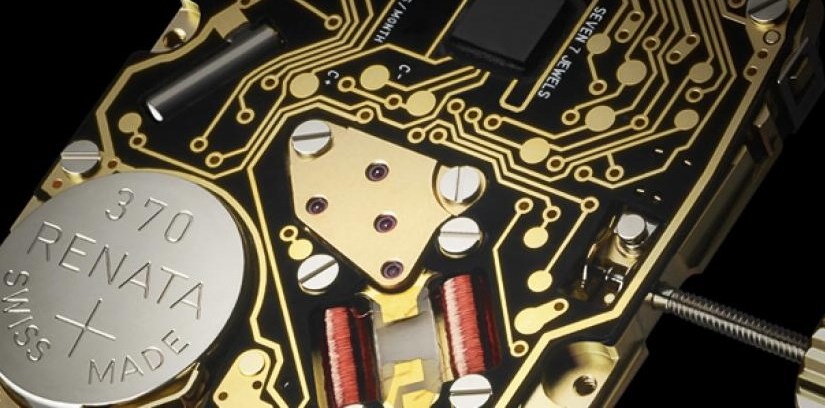
After the introduction of chronograph and calculator and hybrid systems showing analog and digital time on one watch face next to each other, ETA managed to develop a caliber where the analog hands were attached within a big digital watch face in 1983: cal.: ETA 988.331.
Analog / Digital Superposition
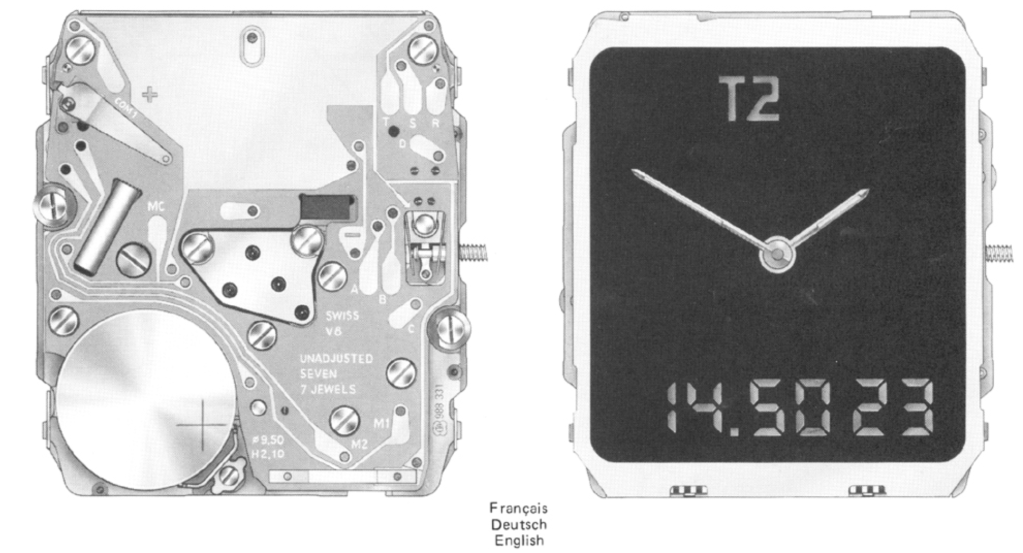
By 1983 integrated circuits were powerful and versatile enough to run desktop computers, and also the watch industry took advantage of these exponential increase in computational power. ETA 988.331 was used in different iterations, by different watch companies. It was even possible to invert the display contrast, displaying silver on black background. However, the most impressive variant was developed for SSIH-ASUAG’s leading company Omega. ETA modified the caliber for Omega to have the digital script shown in a curve, instead of two superimposed lines. This variant will become Omega’s cal.: 1665 and will be used in various ‘Seamaster’ models including the futuristic ‘Seamaster Polaris’ line featuring titanium/gold and titanium/palladium cases.
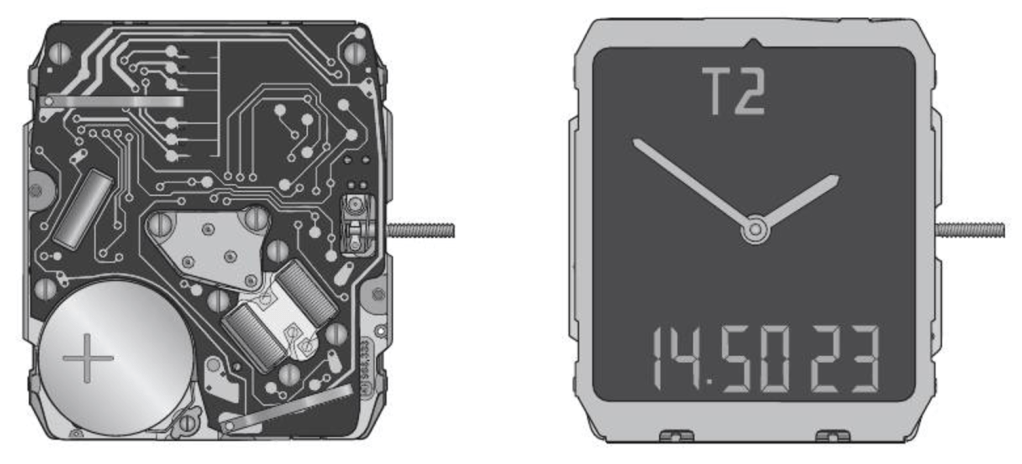
Of course it was envisioned to increase the number of functions of such a powerful electronic movement, but the 988.331 version already equipped with second time zone, date, alarm and chronograph function, was not able to accept additional functions such as multiple time zones, multiple alarms, elapsed timers and background light. The display of the marketed ETA 988.331 shows linear rendering of the functions, a few prototypes exist, experimenting with a curved rendering. The evolution of cal.: ETA 988.331 which would allow further developments was cal.: ETA 988.333, by optimising the electronic circuitry. Also this caliber was readily used by several watch firms such as Breitling for their ‘B-1’ model. This version was also used to test different display versions and fonts in order to increase readability.
A good readability of the watch face coupled with very specific functions were already important prerequisites for the analog developments at Omega within the Alaska Projects for NASA during the 1960/70s. Thus it was a small step initiating research into a new generation of space compatible watches with multiple, specific functions, which this time would be definitively quartz regulated.
From Moon to Mars
Not only NASA was interested in the development of a versatile, functional and reliable watch for working and living in space, also ESA (European Space Agency) Astronauts started to give their inputs according to their experiences made while on space missions.
As Omega was relieved of all their research and development responsibilities linked with calibers, after the building of SSIH-ASUAG in 1983 and the subsequent closure of SSIH-Quartz, it was ETA which was in charge of these developments. After 1983 gradually all caliber research and production within the SSIH-ASUAG group was centralised to ETA, the transition terminated in 1985 with the further reorganisation of of SSIH-ASUAG into SMH. The priority was to develop calibers for firms within the group and inside the group a specific hierarchy had to be respected, the leading watch manufacturer being Omega. In this context, one branch of ETA’s research would thus focus on Omega’s development of a new multifunction quartz watch and later of a new generation of quartz regulated, multifunction ‘space watch’ (6).
As the ‘Moonwatch’ status within the official ‘Speedmaster’ line was already attributed and successfully marketed for decades, it was decided to go one step further and nickname the new development the ‘Marswatch’.
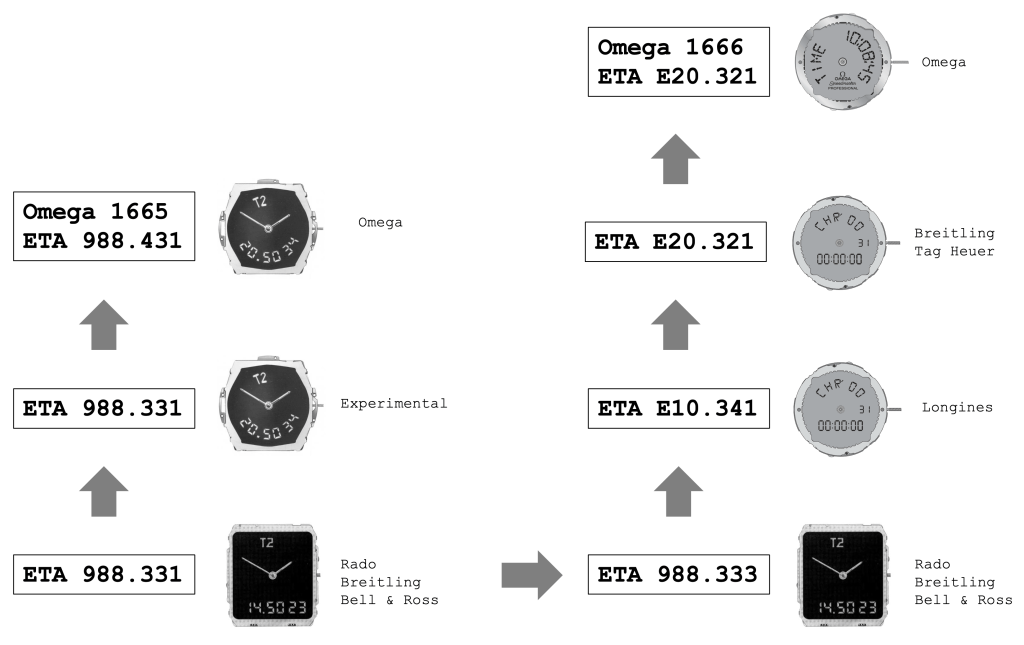
The most advanced caliber suitable for such a development was ETA 988.333. Also here several variations of digital display and fonts were tested. Relevant for the development of the ‘Mars-watch’ were the later versions E10.341 and E20.321, both with partially curved renderings. Especially latter caliber was used as functional prototype to test for space compatible resistance with the newly introduced thermo-compensation and its powerful electronics which allowed for the integration of suggestions made by astronauts, such as a louder alarm. A new feature of E20.321 is also the backlight, which lacks in E10.341, its earlier versions and also all early 988.331 derivates. Starting with cal.: E10.341 chronograph pushers were added to facilitate the manipulation of the chronograph function and the setting of all functions. Even if the intermediary calibers did not fulfil all criteria for Omega’s ‘Marswatch’, they were reliable enough to be presented and sold to other manufacturers (2).
One main issue with these calibers is that the selection of the functions is made by turning the crown. Early in the testing for space use it was clear, that the rotatory manipulation of the crown for function selection is not compatible with wearing space gloves. Hence, one further update which the ETA 20.321 caliber received, is the omission of the rotatory function for selection through the crown and the addition of two pushers. Most probably due to aesthetic reasons and the strategic placement of the Omega logo, the display was turned by 90° and both display lines are curved. Surely because the display is not well readable in this configuration, Omega opted for a straight and horizontal rendering after the first two generations of ‘Mars watch’ (6).
Mars Timing on Your Wrist
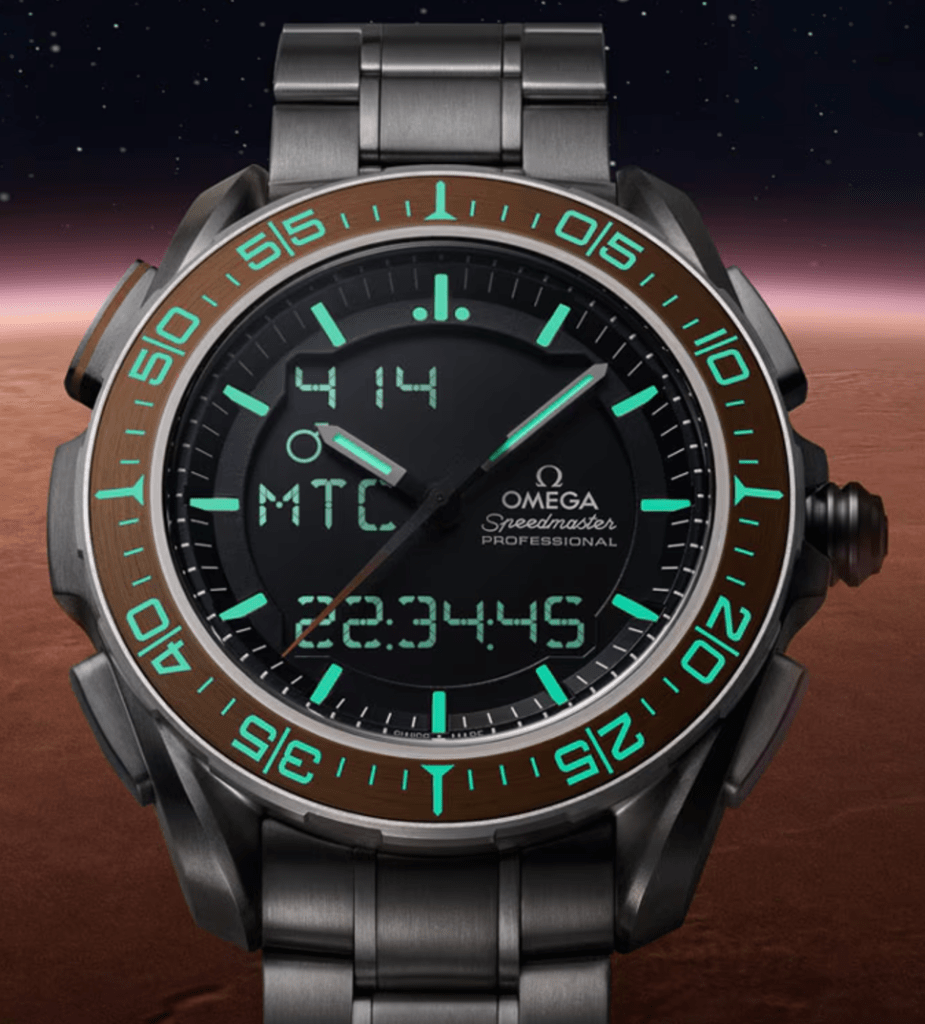
ETA’s multifunction movement is still worked on and functionally enhanced, one more recent iteration being mounted inside Omega’s ‘Speedmaster Marstimer’ issued in 2023. The watch features Omega’s cal.: 5622 which is based on cal.: 5619. Cal.: 5619 movement includes developments originating from an European Space Agency patent license, as it includes features based on an invention by ESA astronaut Jean-François Clervoy. The patent which is owned by ESA, is one of 135 inventions, available for commercial use by non-space related industries. The ETA base caliber for Omega’s cal.: 5622 seems still to be within the E20.321 ‘Thermoline’ family, but with updated electronic elements, software and display (3, 4).
Ref.:
- Manualslib
- Watch-Wiki
- Watchbase
- Calibercorner
- Omega
- Personal communication with former ETA executive
 Electric Watch Prototypes