
8min read
During the beginning of the 1970s horology was passing a major revolution with the global introduction of quartz regulated watches. Apart of this new way of regulating wrist timekeepers also the display by means of rotating hands was challenged through research into electronic wrist watch systems based on the same principles as the analog quartz technology, but with no moving parts. These developments with no moving wheels and hands are also defined as ‘solid state’ systems.
In Switzerland, the idea of time display through electro-chemically induced numeric representation without moving parts was already discussed in 1965 at the CEH, when it was decided to engage into the development of a quartz regulated system instead of an electromagnetic system to directly concurrence the highly successful Accutron system (4).
This idea was put on ice until the electronic developments and the efficiency of small batteries were advanced enough to enable serious research. Obviously the research facilities in the USA had an advantage, as the huge amounts of federal financing into electronic technology would push the development of smart weaponry and the conquest of space, both motivated by the cold war.
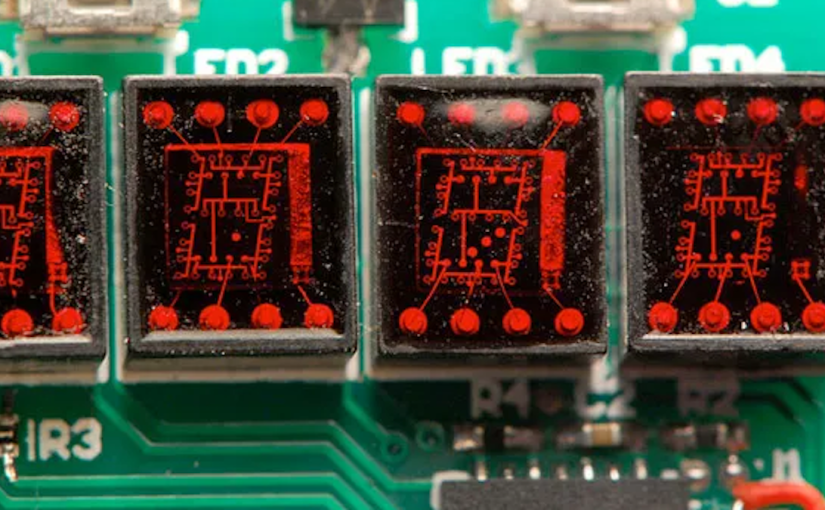
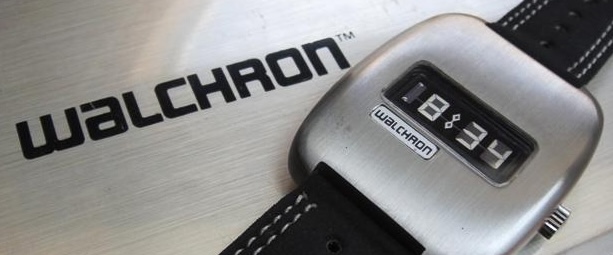
There are three means of displaying the time in digital form: replacing the hands of analog watches (also mechanical) with discs or vertical drums bearing printed numbers (pseudo-digital display), the LED (Light Emitting Diode) display, which historically shows the numbers in red light (in some rare versions also other colours), the LCD (Liquid Crystal Display) display which remains in grey/silver and black contrasting tones and where the numbers can be silver on mirror-silver background, black on silver background or inverted as silver on black background. Latter display version was developed more recently.
The research into LED and LCD display systems were closely linked and happened almost simultaneously, even if the LED system proved easier to implement at first.
LED
The futuristic display of time using luminous numbers was brought to a broad public in 1968 by the movie ‘2001 – A Space Odyssey’, for which the Hamilton watch company was contracted to provide the on screen renderings of time display. The first functioning prototypes developed by Hamilton in collaboration with Electro-Data, founded by George H. Thiess, were ready in 1970 (1).
Hamilton – Pulsar
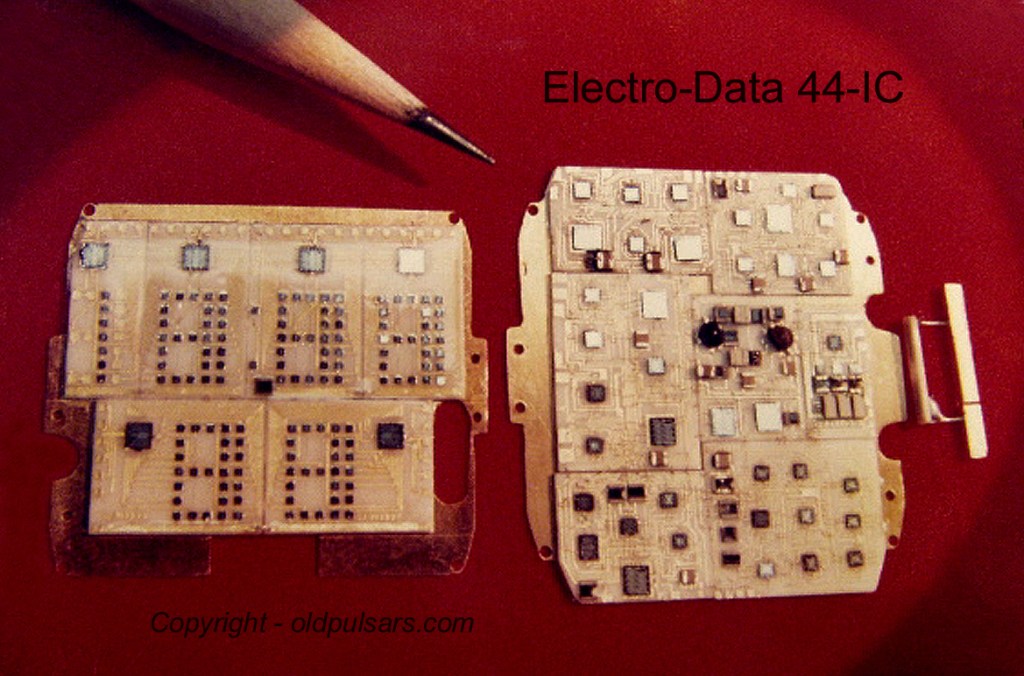
The prototype Pulsar consists of three major components: a time module with display circuits, a quartz crystal, and a battery. Electro/Data had made early progress with developing miniaturised time displays in 1968 and entered into a contract with the Hamilton Company on 1.12.1969 to jointly develop a digital watch. The initial time module had 44 ICs built using TTL technology, equivalent to 3474 transistors. It consisted of seven ceramic circuit boards, each with its own function. The time-keeping signal was supplied by a quartz crystal vibrating at 32768 Hz. The high frequency crystal ensured that the time deviated by no more than three seconds a month. The entire watch was powered by a three-cell, 4.5-volt, rechargeable Ni-Cd battery. Under normal use, the battery lasted about six months. The watch was to come with a replacement battery and charger (2).
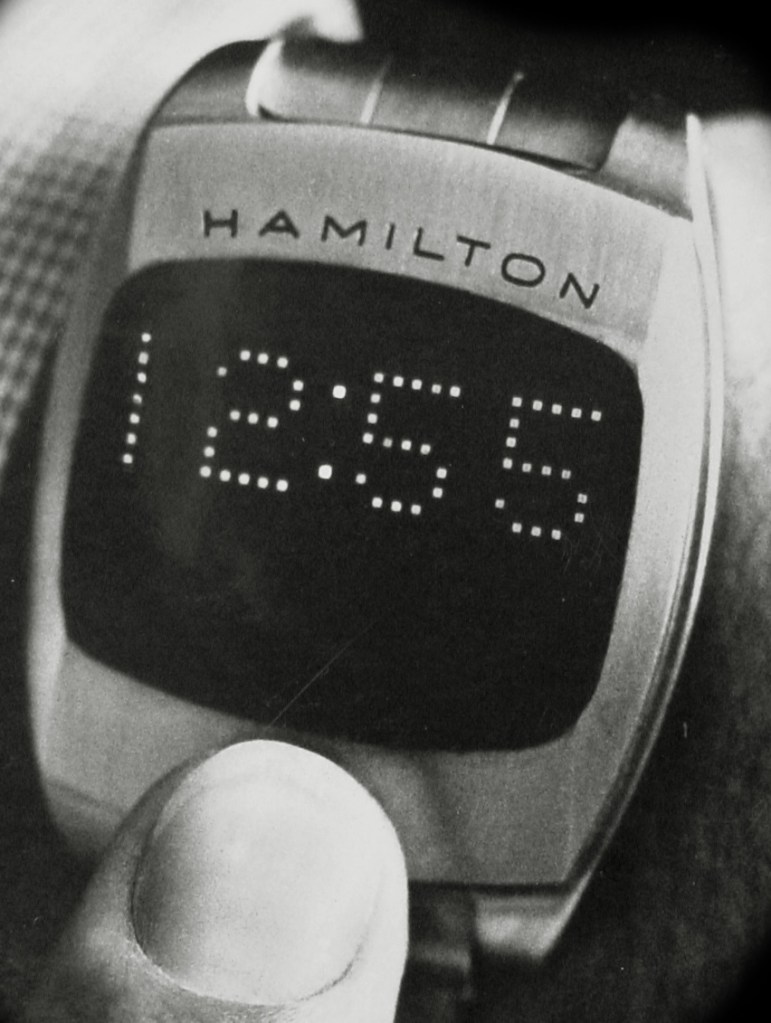
Only the prototype model bore the Hamilton label, all other digital watches made in Lancaster were marked ‘Pulsar’. The Pulsar is America’s biggest watch success story. The initial 400 limited edition gold watches were sold by the end of the first year, despite its high price. The steel model priced at 275$ also sold very well. At the height of the watches popularity, the company was selling ten thousand units per month, outselling every high-end watch in the world. It was also the first such watch imported to Switzerland. Watch experts, such as Henry Fried, consider the digital display the greatest technological leap since the hairspring in 1675. The New York Times called it a space-age ‘wrist computer’ and announced it was ‘a new era in the science of measuring time’. Richard J. Blakinger, then Hamilton president, described the development of the watch as (2):
“A dramatic breakthrough in the science of horology which signals the opening of a totally new approach to the design and manufacture of portable timepieces. Since this advanced product is a fixed program computer, it is conceivable that other programs are possible and that some day in the future there will be a programmable wrist computer which would respond to a variety of useful programs personally selected by the wearer.”
Marketed as a ‘Time Computer’, the Hamilton company would later create a subsidiary called ‘Time Computer, Inc’. just to manufacture and market the Pulsar (2).
LCD
The first observation of liquid crystals dates to 1888 and was made by the Austrian botanist Friedrich Reinitzer. European laboratory scientists came to understand the physics and chemistry of liquid crystals during the 1930s, but it wasn’t until the 1960s that investigations began in the United States in both basic research and practical uses for liquid crystals. Then it became clear that at certain temperatures and with application of electric current these crystals change orientation and visibility, which made them the main target for developing optical screens (5, 7).
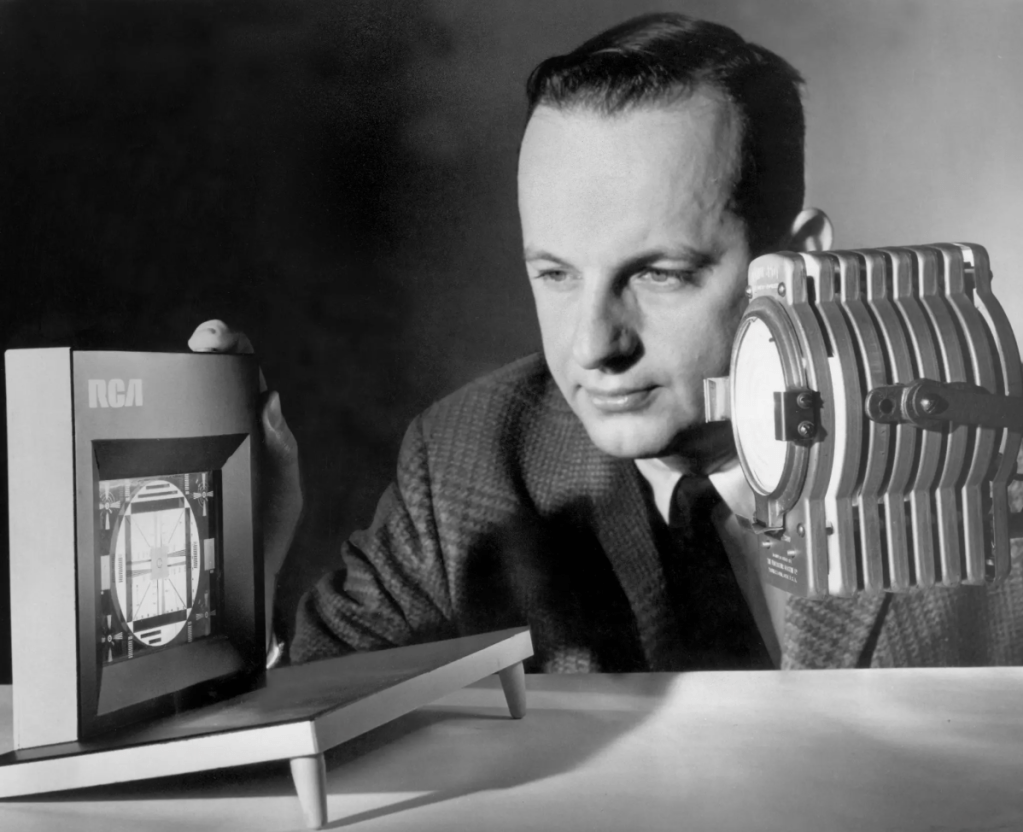
The intense research into the application of such crystals peaked in late 1964, when engineers at RCA (Radio Corporation of America) observed an interesting effect in certain classes of nematic liquid crystals. The materials that yielded the best performance were members of a class of organic compounds known as Schiff’s bases. They found the compound anisylidene para-aminophenylacetate (APAPA) to be of particular interest. Its nematic range was from 83°C to 100°C. In an applied field, these materials exhibited a marked turbulence that turned them from transparent to milky white. George H. Heilmeier discovered a very efficient way to electronically control the reflection of light. The rise time of 1–5ms and decay times of less than 30ms together with DC operating voltages in the 10–100V range made the new mode attractive for such applications as alphanumeric indicators. He named it DSM (Dynamic Scattering Mode). It was the first demonstration that those obscure materials called liquid crystals could be made into something useful. The LCD was born (5).
Heilmeier, Louis Zanoni, and other RCA engineers designed and fabricated prototype devices based on DSM. Alphanumeric displays, windows with electronically controlled transparency, static pictorial displays an all electronic clock with a liquid-crystal readout, and liquid-crystal cockpit displays were fabricated. The 28.5.1968, RCA held a press conference at its headquarters at Rockefeller Plaza, New York. They proudly announced the discovery of a totally new type of electronic display. It was lightweight, consumed little electrical power (as isolated module), and was very thin. The press conference drew the attention of scientific and industrial communities all over the world. This announcement initiated the development of digital watches in the USA, Japan, Germany, the CEH and Ebauches SA in Switzerland as well as the work on pocket calculators in Japan. At the same time, it led to further scientific work in Germany, Switzerland, and the UK, particularly for the synthesis of new liquid-crystal materials suitable for use in display applications (5).
Commercial LCD watches using DSM based displays were only produced for two years 1972 – 1974. Because the DSM LCDs suffered from relatively high power consumption, limited life, and poor contrast, the search continued for a workable LCD. In 1971 James Fergason at Kent State University in the USA invented an improved display system based on the twisted nematic field effect (TN) invented at Roche in Switzerland in 1970. Fergason left Kent State and formed ILIXCO Corporation to manufacture his display. The first LCD watch with an ILIXCO display was marketed by Gruen (model ‘Teletime’). The field effect display is the kind most frequently found in today’s LCD products (7, 8).
Swiss Contribution
Concerning the LED system, most watchmaking firms were relying on American suppliers. Girard Perregeaux opted for a self developed solution with American and French collaborators, which will peak in the development of the ‘Casquette’ model in 1974.
Ebauches SA will lead the project ‘Clepsydre’ together with Longines, Texas Instruments and later BBC to develop a Swiss LCD system based on the DSM protocol and which display will later be replaced by the TN-LCD system. Ebauches SA will soon become the main supplier of LCD quartz calibers to the Swiss watch industry and Casio for their ‘Casiotron’ model in 1974 and once merged with ETA broaden its research into hybrid, integrated analog/ digital multifunction LCD calibers, which will be used and refined well into the 2020s (9).
Ref.:
- Wikipedia
- Pennsylvania Center for the Book
- Dennis L. Klein
- Roger Wellinger Archive
- Kawamoto H., The History of Liquid Crystal Displays, Proceedings of the IEEE, 2002
- New York Times
- Watchismo
- Crazywatches
- Personal communication with a former Executive Vice-President of Ebauches SA, in charge of Research & Engineering.
 Electric Watch Prototypes