
6min read
To concurrence the cheaper and well manufactured Japanese quartz watches the Swiss watch industry had to adapt the manufacture of electronic components and especially the quartz module to be as reliable, precise but also as cheap as possible. Each manufacturing step would need to be optimised for material consumption, manpower and time to get the manufacturing prices as low as possible (1).
The initial manufacture of quartzes for the Swiss watch industry was linked to several peculiarities beginning with the obtaining of natural quartzes from Brazil, which counterintuitively compared to Swiss alpine quartzes, would be bigger and cheaper. As natural grown quartzes need to be painstakingly analysed to find the optimal orientation for cutting at the beginning of the 1970s, research on laboratory grown quartzes sped up leading, by the mid 1970s, to the production of large quartzes with more ideal crystalline growth orientation, facilitating the selection of good quality pieces for quartz resonator manufacture (1).
Also, during the mid 1970s it became clear, that the Swiss method of using bar shaped quartzes as resonators was suboptimal. The Japanese watch industry was using exclusively tuning fork shaped quartzes, already since the onset of their quartz development. Ebauches SA had decided in 1975 to completely convert their production to the use of tuning fork quartzes, at first imported from ‘Statek’ in the USA and afterwards using in-house quartzes produced completely with photolithographic method after obtaining Statek’s license (2).
The Omega Way
After having developed, in collaboration with the Battelle Institute in Geneva, the high frequency quartz system peaking in the model ‘Megaquartz 2.4Mhz’ using super expensive, round, pill shaped quartzes and having contributed to the development of the Beta 21 caliber within the CEH consortium, Omega, as part of the SSIH group, wanted to remain completely independent from Ebauches SA. Latter was part of the then concurring ASUAG, which Oscilloquartz division would manufacture most quartz resonators for the Swiss watch industry. Therefore, Omega as contributor of the new SSIH-Quartz division founded 1974, decided to have its own resonator manufacturing lab and develop their own bar shaped quartzes and after Ebauches SA converted their production to tuning fork quartzes in 1975, SSIH-Quartz and thus Omega converted their production to these better performing and smaller quartzes as well. But to the contrary to the proven and refined photolithographic method used by ‘Statek’ and later Ebauches SA, SSIH-Quartz opted for a slightly alternative route (1, 2).
SSIH-Quatz’s protocol for Omega would differ from Statek’s manufacturing method by including more mechanical steps instead of completely photolithographically etching the tuning fork shaped quartzes, which despite consisting of less varied manufacturing steps, is very time consuming and thus more expensive. The ‘Omega method’ consisted in slicing a quartz block, then mechanically micro-machine it to look like a comb. The surfaces would then be polished and afterwards photolithographically etched for further smoothing the surfaces and reaching the definitive tuning fork shape for a given resonance frequency. Finaly the quartzes were cleaned, and a thin metal hard mask (typically Chromium/Gold – Cr/Au) was sputtered onto both sides, followed by photoresist coating and again an etching process to smoothen the coating (1, 2).
Fabrication Problems and Scientific Solutions
Despite the high precision manufacturing, the first Omega watch prototypes mounted with these in-house, tuning fork shaped quartzes showed frequency shifts, which could not be explained with the aging process of the quartz or other known adaptations of the system through use. Moreover, the frequency shift got more important when the quartz would oscillate for longer periods and thus the resonance frequency error would get worse with prolonged use. The experts at Omega and SSIH-Quartz could not see micro-fissures under the microscope, which would explain the effect, so they had to look for more elaborate scientific methods to evidence the problem. For analyzing the issue, Omega contracted the Crystallographic Institute, a conjoined facility of the University of Zurich and ETH Zurich. Their experts applied the ‘Lang technique topography’, which is an old, non-destructive imaging technique used to visualise defects within single crystals like quartz. This technique is particularly used for evaluating the quality of quartz resonators and raw quartz materials, allowing for the mapping of structural imperfections across large crystal areas. The topogram (see picture below) shows the ‘screw dislocations’, micro-defects on atomistic level and the defects from the removed electrodes (typically Chromium/Gold – Cr/Au). The quartz crystal is oriented such, that a specific lattice plane, in this case the (110), satisfies the Bragg condition (Bragg’s law: fundamental relation in crystallography that describes when X-rays are constructively diffracted by a crystal lattice). The Crystallographic Institute concluded that the slots machined for forming the arms of the tuning forks triggered these ‘screw dislocations’, causing the frequency shifts (1).
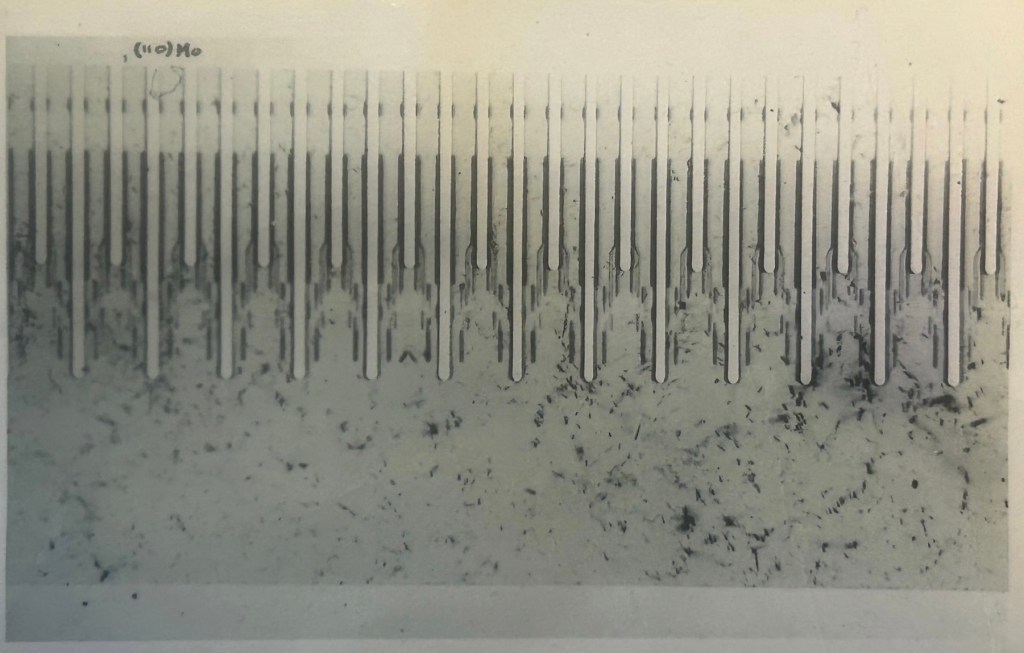
Once Omega was informed about the problem, the manufacturing process was adapted by reducing the depth of the gap between the tuning fork arms and by increasing the etching time to reach the final dimensions of the forks. The frequency shift encountered due to the mobile screw dislocations in the tuning forks could thus be resolved by adapting the fabrication process. The prolonged etching time reduced the number of defects introduced by the cutting process and therefore the risk of propagating defects (1).
A Silent Amelioration
The switching from using bar shaped quartzes to tuning fork shaped quartzes is not discernible in Omega quartz calibers, the housing remained oblong and did not change shape as was the case with the quartz output by Ebauches SA. Omega used these ‘in-house’ quartz modules with tuning for shaped quartzes most probably starting with caliber 1320 until the merger with ASUAG in 1983, when exclusively quartz calibers originating from ETA were adapted, which were using the tuning fork shaped quartzes produced photolithographically following the ‘Statek’ protocol (2).
Ref.:
- Personal communication with a ETH Zurich solid state physicist working on this project, he was later Professor at the University of Bern, now emeritus.
- Personal communication with a former Executive Vice-President of Ebauches SA, in charge of Research & Engineering
- PD Dr. Melchior Fehlmann, Crystallography Institute of the University of Zurich

