
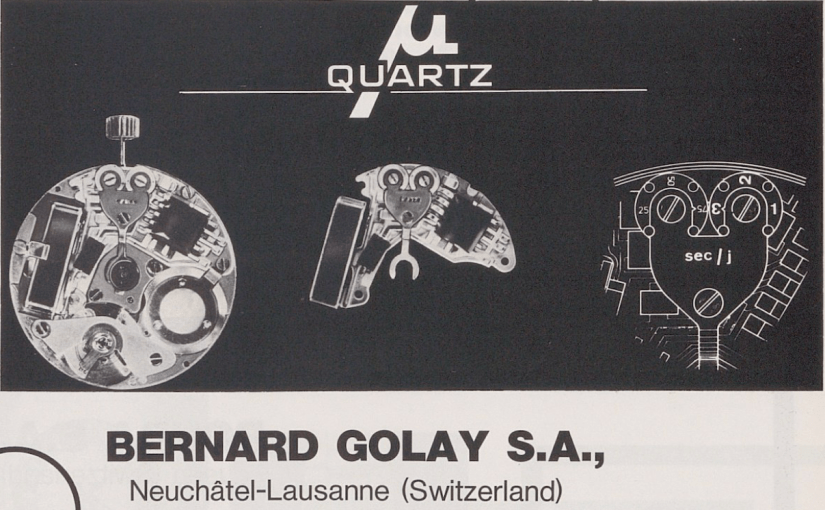
B. Golay SA of Lausanne has contributed massively to the development of Longines early quartz watches by creating the concept and the electronic circuitry for the experimental pieces which won the observatory chronometer competitions in their respective categories in 1964, 1965 and 1966, but also by creating the concept and construction of the electronic components for Longines cal.: L6512 for the ‘Ultra-Quartz’ model. The different developments can be seen in their respective, dedicated sections of this site (1).
A New Focus
During the development of cal.: 6512 for Longines and the final market introduction of Longines ‘Ultra-Quartz’ model in October 1971, the engineers at Golay concentrated their efforts also in developing an in-house quartz watch, while taking into account the recent developments in integrated circuitry (IC) and the miniaturisation of the quartz crystals (1).
The new development retained the newly introduced principle of the electronic element featuring a CMOS circuitry autonomously comparing and synchronising a mechanical oscillation (this time a balance wheel) and a higher frequency (32KHz) quartz oscillation. This will give rise to Golay SA’s second ‘cybernetic’ watch movement and one of the most interesting yet underrated, battery driven Swiss watches (1).
The Micro-Quartz
Also the brain child of Jean – Claude Berney, this development was intended to revolutionise quartz driven watches in terms of precision, versatility and especially low costs of development and production, such as not to repeat the delaying mistakes experienced for the development and industrialisation of Longines ‘Ultra-Quartz’ (1).
This time the electronic circuitry could be build smaller, with use of an CMOS integrated circuit developed at Golay but custom made by RCA (Radio Corporation of America). The smaller bar shaped quartz was also sourced from the USA, as Oscilloquartz SA was not able to provide such a small quartz at that time. The motor would be a balance wheel set-up which oscillation, as in the case of the ‘Ultra-Quartz’, needed to have an inbuilt frequency instability, which would be constantly, ‘cybernetically’ corrected by the electronic circuitry. In case of this balance wheel assembly the error was introduced by a flat, slightly asymmetric balance spring (1).

As for the ‘Ultra-Quartz’, the circuitry would give up to five impulses to the motor if it was too slow and one impulse, if too fast (1).
Also other features were taken over from the ‘Ultra-Quartz’ model such as the positioning of the hand adjusting crown on the back of the case. The date adjusting crown is separated from the hand adjustment and placed at ‘4’ at the right side of the case.
A completely new design element was the case, which as for the Omega Speedmaster ‘125’ and other contemporary Speedmaster references used a modular, three part system. The idea was to enable an easy change between outer case styles, without the need to expose the movement.
The only Swiss – Japanese strategy
Interestingly, as the only Swiss watch developer at that time, Golay’s concept for the production of this watch followed the strategy of the Japanese manufacturers, where the engineers would develop the watches integrating the procedures for industrial production into the initial conceptualisation. Latter strategy highly contributed for the Japanese to win the race for the first industrialised quartz watch a few years before. Moreover, to the contrary of all other Swiss watch manufacturers committed to quartz watches at that time, Golay understood, that the core market was looking for affordable quartz watches and not luxury versions (2).
The gained experience in developing quartz movements for several years permitted Golay SA to develop cal.: FB7723 (date) and cal.: FB7743 (day/date) in record time. After little more than one year of development the ‘Microquartz’ was introduced at the Basle Fair 1972 with a subsequent manufacture of a ‘zero-series’ of about 2000 pieces with the financial support of the brand ‘Mirexal’ which belonged to the Swiss grocery chain ‘Migros’ and which planned to order a considerable amount of ‘Microquartz’ watches to be retailed in their stores. Golay SA wanted to market the watch on their own and had also incorporated into their ‘zero-series’ versions with the brand names of other interested mid-range watch retailers such as Betina, Record, Bouvier, Levrette, Concord, B.C.I. and as mentioned Mirexal. Golay would produce the complete watch series for the respective watch retailers. Even Longines pre-ordered a small amount of ‘Microquartz’ models but imposed a better than average finishing and slight modification of the case back to fit their commitment to highest quality (1).
As a true visionary, Bernard Golay also started the expansion of the firm by constructing a facility in India, where watches would be produced locally for the rapidly expanding Asian market, they would feature the brand name ‘Hedge-Golay’. The sales of the ‘Microquartz’ were intended also to finance this risky venture in Asia. Some parallels to Hayek’s plan to resurrect the Swiss watch industry in the early 1980s can be drawn.
A Tiny Problem with Catastrophic Effect
Unfortunately a tiny conceptual error in the mechanical part of the movement would completely sabotage the marketing of the watch. ‘Migros’, after being confronted with the low reliability of the watches of the zero-series retracted from the agreement with Golay, which as a indirect consequence would force Golay into bankruptcy by April 1975. Most pieces of the zero-series have been destroyed after Golay’s bankruptcy, projecting the Microquartz wrist watch to a rare collectors piece. Unfortunately of the few which survive, most don’t work (1,3).
The mechanical problem consists in the interaction of two wheels: one with 60 teeth and one with 59 teeth, these wheels are supposed to mechanically sustain the electronic frequency division to move the second hand. Because of this mechanical flaw, many movements have also difficulties to move past ‘midnight’ as soon as the date wheel is supposed to switch. Therefore most ‘Microquartz’ watches tend to stop at ‘midnight’ losing their reliability (1).
On a Personal Note
While searching and researching rare Swiss battery driven watches, I have the immense privilege of meeting some of the people directly involved first hand in the development of these pioneering timekeepers. Besides learning the technical, historical and scientific background to these developments from them, some of these encounters create an invaluable bond and lasting friendships.
During one of the discussions with the last leading engineer working for Golay SA until 1975 (who wants to remain anonymous), who was developing the system and the electronic circuitry for the ‘Ultra-Quartz’ and the ‘Microquartz’ wrist watches, he told me that ironically he never owned a ‘Microquartz’ apart of one prototype which he wear tested in 1971. This was for once the opportunity for me to give something back to one of these important pioneers who have been resting in the shade of horological history for decades. Moreover, the engineer had been more than generous in selling me the last remaining material linked to the manufacture of the ‘Ultra-Quartz’ and ‘Microquartz’ developments, as well as several bulletins of the Observatory in Neuchâtel, where the experimental prototypes made by him and his team won numerous chronometer competitions during the 1960s.
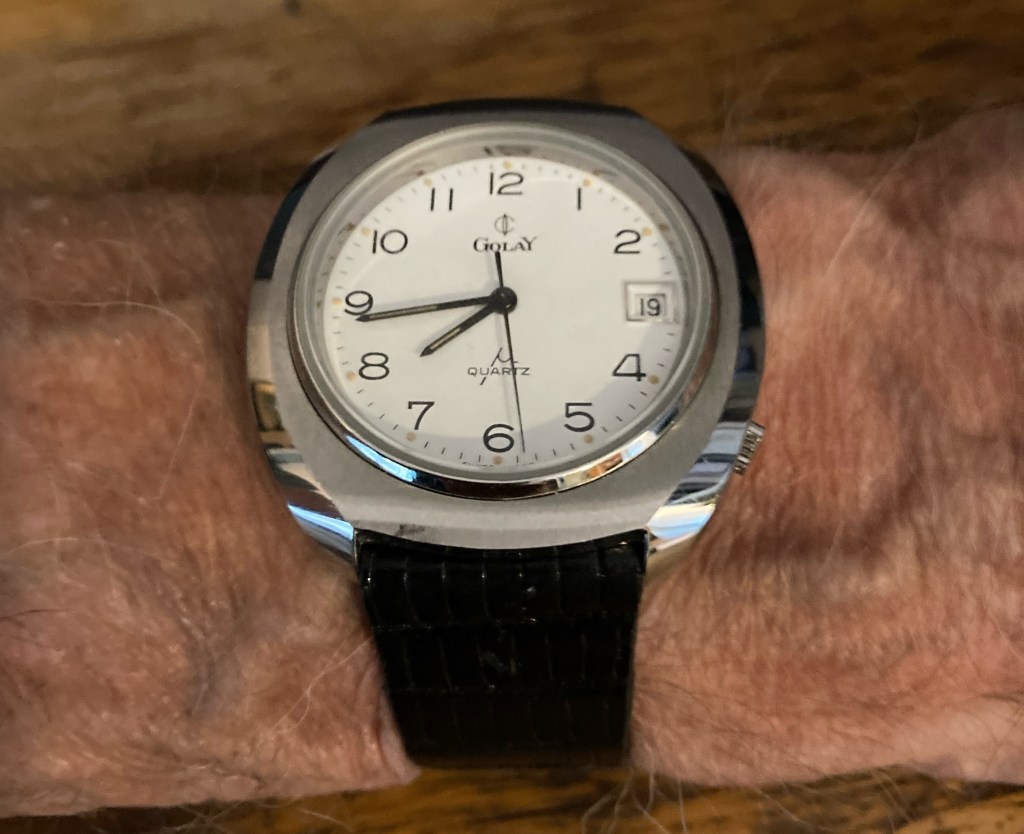
Concerning the ‘Microquartz’, he told me that the plain versions with white dial and the ‘Golay’ branding were his favourites. This was the starting point of the challenge for me to find one such ‘Microquartz’ to offer him as a gift. A few months later, out of nowhere, I had the opportunity to buy exactly such a ‘Microquartz’ and I supplemented it with a black custom made leather strap. At the end of the following meeting I presented him the watch and you won’t believe the sparkle in his eyes when he saw it. The joy was mixed with the disbelieve that I have managed to find exactly the version he mentioned. He immediately put it on his wrist and declared that this watch would be cherished and later past to his son as heirloom, accompanied with the history behind its development, which he never shared with his family before.
Ref.:
- Personal communication with a senior engineer directly involved in the prototype and watch developments and construction at B. Golay SA from 1965 to 1975. He co-developed the circuitry for the ‘Microquartz’ model.
- Donzé P.Y., Dynamics of Innovation in the Electronic Watch Industry: A Comparative Business History of Longines (Switzerland) and Seiko (Japan), 1960-1980, The Journal of the Economic & Business History Society , © 2019, The Economic and Business
- Gazette de Lausanne, 10.3.1975
 Electric Watch Prototypes