
6min read
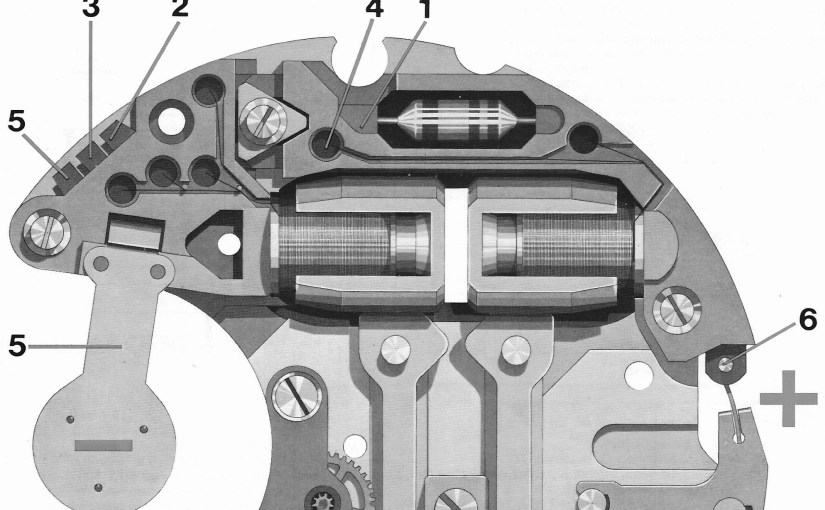
In parallel to the advanced developments of the Centre Electronique Horloger (CEH) and later Omega towards the ‘Megasonic’ tuning fork movement, also Ebauches SA (ESA) invested very early in the further development of the tuning fork system, but patent infringement accusations from Bulova gave rise to very harsh negotiations, which ended with ESA licensing Bulova’s ‘Accutron‘ system starting from mid 1967.
An important aspect which must be taken into account is, that Max Hetzel, inventor of the ‘original’ tuning fork system named ‘Accutron‘ (1953/4) and inventor of the CEH – Swissonic movement (1963 – 68) has nothing to do with the ESA – MOSABA development, which was exclusively made by ESA engineers, mainly André Beyner, René Besson and Rémy Chopard (5).
Although not personally involved, most probably the recruitment of Max Hetzel by the CEH in 1963 triggered the motivation of Ebauches SA (majority shareholder of the CEH) to develop their own all Swiss tuning fork system. Working prototypes were already available 1965, the movement principles being submitted for a patent in Switzerland the 29.03.1966 (US – 3.1967), just in time for the system to be presented at the Basle Fair 1966, already attributed with its nick name: ESA – MOSABA (MOntre SAns BAlancier), or ‘watch without balance wheel’ (5).
The aforementioned earliest working prototypes of 1965 were in form and size of small pendulettes. Surely not more than 10 numbered pieces were made and all of them were tested at the Observatory of Neuchâtel, albeit not all participated to the chronometer competitions. These pieces were proofs of principle, where it seems that in each of the 10 versions different placements of the indexing fingers were researched, as well as the lowest possible battery consumption. Latter being a problem shared with all electric and later electronic wrist watch developments of the era. These versions would help to crystallise the best construction principle to ensure best precision performance and position stability. The knowledge gained from these pendulettes would permit the development of the wrist watch sized version of 1966 (1).
Observatory Testing
In 1966 the MOSABA caliber, now of wrist watch size, also competed at the chronometer competition of the Observatory in Neuchâtel against the ‘CEH-Swissonic’ prototypes. The MOSABA prototype winning the competition in its category of ‘electronic wrist watch chronometer’ (despite not being electronic). The excellent performance of the MOSABA wrist watch caliber at the chronometer competition of 1966 together with the performance of quartz pendulettes submitted by Longines, definitely fissured the wall the Swiss watch industry had built to protect itself from developing new electronic wrist watches, including the quartz system, and fuelled the research into the topic.
To the contrary of Omega, which later was heading towards using a higher frequency system attaining 720Hz with the ‘Megasonic’, ESA decided to go for a lower oscillation frequency of 300Hz. As both other Swiss tuning fork versions CEH-Swissonic and later Omega Megasonic, ESA managed to better the peculiar position errors encountered in the original ‘Accutron’ system, by creating a highly symmetrical, weighted tuning fork.
The patenting from Bulova
Bulova‘s policy from the beginning was to grant an exclusive licence of their tuning fork system for Japan to Citizen and to refuse any licence for the US and European (including the Swiss) market, putting the maximum pressure on its competitors in those markets. This was also the main driver for the Swiss to create the Centre Electronique Horloger (CEH) starting from 1960 and the main motivation for Ebauches SA to heavily finance it. Once the MOSABA patents were granted to Ebauches in mid 1967, thanks to the negotiations of André Beyner, Bulova was legally obliged to grant to Ebauches SA a so called obligatory licence with fees which would not be judged punishing, preventing Ebauches SA to market devices produced under their own MOSABA patents (5).
As in all such negotiations, the parties started out with exaggerated claims and dragged their feet for extracting from the counterpart some concessions, finally Bulova, seeing the route coming from triumphal inroads with the quartz wrist watch, caved in and cashed out quickly before it became too late, getting quite a good chunk of upfront payments from the super rich Ebauches SA, which held his fortune with the SBS/SBV banks. In retrospect Ebauches SA was left holding the bag, since Bulova acted after the motto: Don’t go down with the ship, SELL IT! (5)
As the Ebauches SA patent for the MOSABA system was new, despite being based on the Hetzel/Bulova patents, Ebauches SA was entitled to ask Bulova for a manufacturing licence on reasonable terms for the use of the pre-1967 Hetzel patents. The procedure ended in mid 1967 and was celebrated as a great victory for Ebauches SA, and André Beyner specifically, over its Swiss competitors, in primis Omega, who later will buy such MOSABA calibers from Ebauches SA for their f300 line (5).
Once the licence conditions were agreed upon with Bulova, Ebauches SA finalised their development in 1968, starting production and giving rise in late 1969 to cal.: 9160 (no date) and cal.: 9162 (date), in 1971/72 the caliber line was complemented with cal.: 9164 (day / date). One further development would include a chronograph module by Dubois-Depraz creating cal.: 9210 added to the line in 1972 (4). Latter movement was used by Omega as cal.: 1255 and also used to construct one part of the Alaska III prototypes submitted to NASA, which will be marketed as ‘Speedsonic’ later. All these MOSABA derivates were produced at the ‘Ebauches Electronique Marin’ facility created in 1970 (5).
Swissonic 100: The Name Mix – Up
As mentioned in the dedicated section, Max Hetzel came up with the name ‘Swissonic’ while working at CEH. According to Swiss law, the copyright for the use of that name belonged to CEH. Upon withdrawal from research into that movement, the name was sold to ESA where it was used to promote one of their lines of electric movements, ‘Swissonic’ 10, 100, 1000, 2000; cal.: 9150, 9162/9210, 9173 (Beta 21, later transferred to 9180), 9260 respectively (2).
Thus ‘Swissonic 100, would designate the ESA MOSABA calibers 9162 and 9210, of which different prototypes exist. Most can be attributed to the aesthetic category and were used to present their tuning fork system to potential buyers. Therefore, one needs to separate two different watch categories named ‘Swissonic’: The rare original Hetzel-prototypes from CEH and the abundant, later and different ESA versions for witch the name ‘Swissonic’ was bought off CEH and reused.
The original Hetzel – ‘CEH – Swissonic’ – prototypes have no developmental relation to ESA’s ‘Swissonic’ models.
Ref.:
- Personal communication with engineers working at the development of the MOSABA caliber
- Bramaz H.-R., Baumann H.; Die Elektrische Armbanduhr, Band 1, Verlag Stutz Druck AG, Wädenswil, 2013
- Trueb L. F., Watch Around Nr. 10, 2010 / 2011
- Watch Wiki
- Personal communication with a former Executive Vice-President of Ebauches SA, in charge of Research & Engineering.
- Watchonista
 Electric Watch Prototypes