
5min read
In the mid 1970s the standards of quartz calibers for wrist watches were set: tuning fork shaped quartz resonator, CMOS integrated circuitry and stepping motor. All of these features were introduced to the market by the Japanese watch industry, which greatly contributed to the later Swiss ‘Quartz-Crisis’. The frequency of oscillation levelled at 32kHz, even if some firms were setting themselves apart using higher frequency regulation, which promised also higher precision (2).
However, even if the Swiss persevered following the principle, that the most precise watches should be also the most desirable watches, by the mid 1970s the market started to disagree, as the superior precision of a ‘basic’ quartz watch with 32kHz as compared to the mechanical versions was largely sufficient for everyday use (2).
The reaction of the global watch industry was to diversify the quartz developments. One such development consisted in challenging the analog three hand display of time through research into the miniaturisation and adaptation of optic displays such as LED and LCD. These were already available for scientific use starting from the late 1960s in the USA (2).
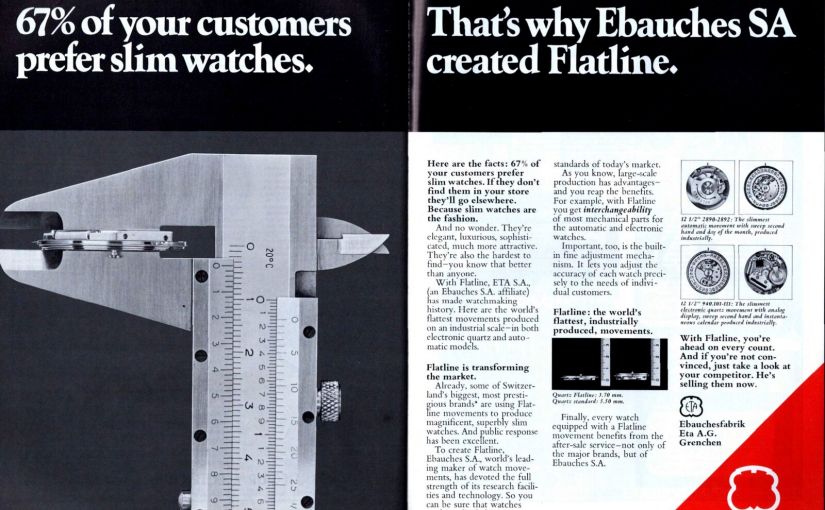
The Market wants Slim Watches
The other branch of development was scrutinising ways to make the quartz calibers smaller. On one side to be able to produce ladies watches, a market segment which had been neglected during the onset of the quartz revolution, due to the technological limitations (mostly due to the size of the available batteries) only permitting to produce relatively large calibers. On the other side, the watch manufacturers who did not fully commit into the electrification of watch calibers, were reducing the size and the thickness of their mechanical calibers, producing elegant and slim watches, which were highly successful with the end consumer (2).
After more than a decade trying to fit electronics and a battery into a wrist watch case, the new challenge was thus to reduce the thickness and the size of these calibers. With their advanced experience in constructing small CMOS circuits locally and the longer experience in manufacturing small, tuning fork shaped quartz elements, the Japanese could sustain their lead on the market. By 1975 the Swiss recognised, that the only way to remain competitive was stop re-inventing all elements locally and to start importing already refined electronic elements from abroad and then ideally licence the manufacture of such elements. The ideal physical properties of bar-shaped quartzes (very high quality factor) had prevented the Swiss for a long time to adapt to the manufacture of tuning fork shaped quartzes, which even if showing a minor quality factor would show big practical advantages. Two such fundamental advantages are, the smaller size of such quartz modules and the suspension of a tuning fork shaped quartz is more (shock-)resistant than the suspension of a bar-shaped quartz.
Consequently, the first big step after the opening of MEM (Micro Electronique Marin) by Ebauches SA in 1975 was the transfer of knowledge and obtaining the license from ‘Hughes Microelectronics’, Newport Beach (CA). MEM was then able to introduce powerful CMOS IC’s and they also decided to additionally switch from bar shaped quartzes to tuning fork shaped quartzes sourced from ‘Statek’ in Orange California, cutting off their very own in-house supplier of quartz modules, Oscilloquartz SA (2).
With the appropriate tools and protocols now incorporated into the Ebauches SA manufacture, the team led by André Beyner could start tackling the development of new, thinner quartz calibers (2).
ETA 2892 and its Electronic Twin
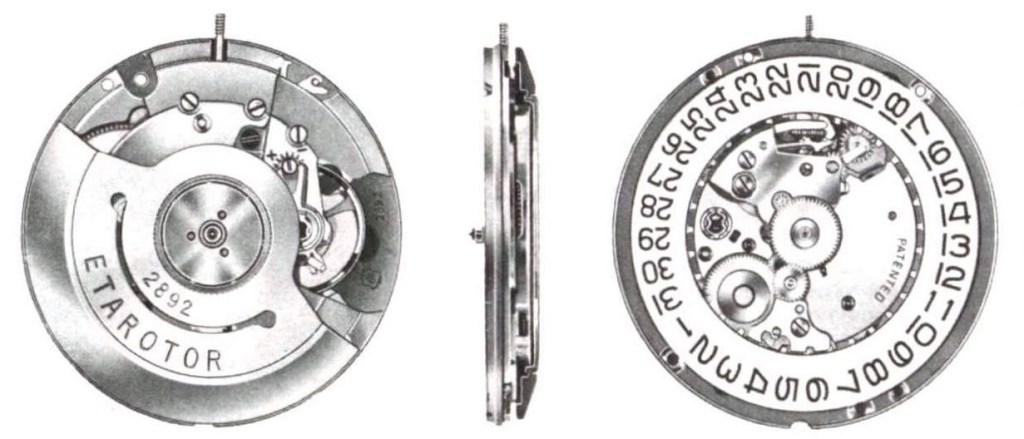
ETA was part of the ASUAG (Allgemeine Gesellschaft der Schweizer Uhrenindustrie) group together with Ebauches SA since 1931 and, as other watch parts manufacturers in this group, was specialised in specific caliber developments. One important milestone in the development of ETA’s calibers was the slim, automatic caliber 2890 (2892 with date) invented by engineer Anton Bally and introduced in 1975. This gave rise to ETA’s mechanical ‘Flatline’ caliber family (1).
To assure the slimness of a future quartz caliber, André Beyner of Ebauches SA decided to merge expertise with Anton Bally of ETA.
The first step was to try and fit the needed electronic elements onto the main plate of cal.: 2892 and then reduce the thickness step by step. The electronic adaptations were developed in parallel to the refinement of the mechanical development.
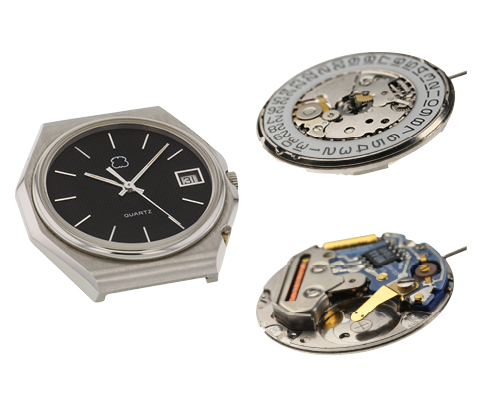
The resulting caliber was named ESA/ETA 940.111 and marks the first version of the ‘940 Flatline’ quartz family. It was released in late 1977 and it was then marketed as the then slimmest (3.7mm) industrially produced wrist watch quartz caliber (1, 2).
This first caliber of the ‘Flatline quartz’ family was rapidly improved upon. The successors of caliber 940.111 were equipped with better performing CMOS electronics, which also allowed for longer battery life. Intensive research into the optimisation of batteries permitted to have gradually smaller and thinner batteries, which greatly contributed to further decrease the thickness of the quartz calibers. The later very successful and even thinner ETA 254.112 caliber (3mm) contributed to the gain in confidence leading to the acceptance of the challenge for developing the Delirium Tremens, the record holder for the thinnest watch ever in 1979, with an overall thickness of 1.98mm.
Ref.:
- Grail Watch Reference
- Comunication with a former Executive Vice-President of Ebauches SA, in charge of Research & Engineering.
- ETA SA
 Electric Watch Prototypes