
6min read
The electro-magnetic wrist watch system was at first represented by the model ‘Accutron‘ developed for the American watch firm Bulova.
Despite the ‘Accutron‘ watch being of an American watch company, its inception happened in Bienne. Not only was the ‘Accutron‘ tuning fork system the first wrist watch technology without balance, but the history of its development is highly relevant for the understanding of the development of the Swiss electronic watches, especially the metal tuning fork regulated ones.
1952 – 1954: First Prototypes in Bienne

After 2 years of research and the Swiss patent (#312.290) granted in 1953, the first 8 hand made prototypes were created, but then starting from 1957 further development was transferred to New York, where Max Hetzel, starting from 1959, managed to perform the technology transfer and supervise the construction of specific machinery to bring the system to industrial production by 1960. Hetzel was so convinced of the success of the system invented by him, that he turned down a very lucrative job offer by Omega before heading to NY (6).
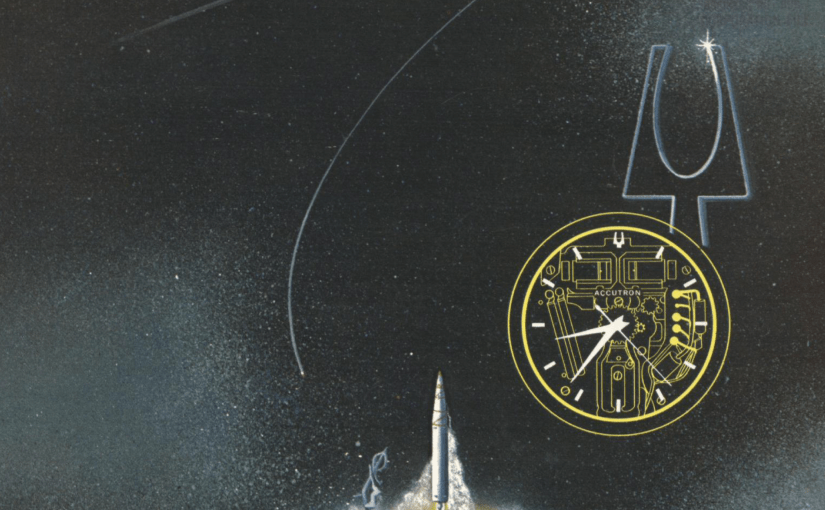
The ‘Accutron‘ tuning fork system has revolutionised portable timekeeping, being considered by some as the most important horological invention of the last 300 years, but also introduced never seen before precision for alternate applications. This was the first wrist watch sized system working without a balance and boasting a frequency of 360Hz with subsequent, unequaled precision for the period. The ‘Accutron‘ system officially being announced in October 1960, Bulova had already established collaborations with NASA and the US Ministry of Defence for the use of the ‘Accutron‘ system in satellites, various generations of manned space flight devices including the later developed ‘Apollo LEM’, but also systems for military application. The technology behind the ‘Accutron‘ tuning fork system was already intensively researched by Hetzel during his diploma – thesis at the ETH Zurich, in which he researched and discussed the physics of tuning forks (2, 3).
1959 /60: American Prototypes and Production

The project moved on with the production of about 100 prototypes running with cal.: 114 or 114P in early 1959, mounted in gilt brass and 14k gold cases (numbered 862-xx) and given to high ranking executives for secret ‘functional testing’ on their wrist. Later in 1959 followed the transition to manufacture with final tooling and refinement of techniques for commercial production. The initial promotion and industrial production of the first ‘Accutron‘ watches with the refined cal.: 214 started in November 1960. Bulova used a very straight forward date code marking their early ‘Accutron’ movements and cases with ‘M’ and the cyphers ‘0 – 9’ for production ‘1960 – 1969’. This cal.: 114 would be slightly modified and renamed cal.: 214 (2, 5, 6).
New Logo is Required

In addition to the development of the movement and the design of the case, some of which will be highly futuristic and asymmetrical, also a new logo for the new system was envisioned. As a salient design feature and obviously being the central technological innovation an idealised tuning fork symbol seemed appropriate. The design of the logo was finalised in September 1960, which is just a few weeks before the official announcement of the ‘Accutron‘ model. Most watches belonging to the ‘zero-series’ would not bear the new logo on their dial, only the ones produced in a later stage, just before the end of 1960 will have the new tuning fork logo at ’12’. The habit of complementing the development of a new watch system with a corresponding logo started with the development of the electric watch and will be retained also for the future development of the quartz watch.
Enormous Success
The ‘production’ of cal.: 214 movements and complete watches started in late 1960, confirmed by the ‘M0’ marks on the respective cases. These watches can be considered to belong to the ‘zero-series’, which started selling in the USA before Christmas 1960. The response of American customers to this new watch was extraordinary, but to magnify the international impact of the system, Bulova decided to declare the official launch of the watch upon international presentation. Therefore, the official launch of this system, named ‘selling phase’ by Bulova, started at the ‘Basle Fair’ of 1961. Later the system was also presented at the ‘International Trade Fair in Tokyo’ (starting 17.04.1961) and also at the ‘EXPO 61’ in Milan, starting 01.05.1961(2).
The ‘Accutron‘ watch experienced a world wide success, being issued in countless variations of which the ‘Spaceview’ appears to be the most coveted.
Accutron ‘Spaceview’

The newly introduced ‘Accutron‘ system, technologically and optically different compared to all classical portable timing devices, needed to be introduced to the resellers also. The resellers had to know some basics about the new system in order to advise potential customers. A part of written information, technical drawings and training movements sent out to watchmakers, resellers received plastic models of the ‘Accutron‘ system as well as display watches lacking the dial to put in their shop windows. Customers intrigued by the dial-less versions in the window of the retailers, wanted to buy these and not the versions where the revolutionary movement is hidden. Under the pressure from the resellers, Bulova decided starting 1961 to market a dial-less version of the ‘Accutron‘ calling it ‘Spaceview’. This was the first model lacking a dial and permitting a full view of the futuristic movement, showing green plastic elements, transistors, the coils producing the electromagnetic field and a big part of the tuning fork assembly. This model was extremely successful for several years, until the quartz driven watches took over the market for battery driven wrist watches towards the mid-1970s (14).
The early and sustained success of the ‘Accutron‘ accelerated the need of the Swiss watch industry to invest into the development of electronic watches, which will culminate in the development of the first quartz wrist watch in 1967.
Ref.:
- Bulova Annual Report 1960
- Bulova Annual Report 1961
- Bulova Annual Report 1969
- Watch-Wiki
- Bulova Date codes: My Bulova
- Trueb L. F., Ramm G., Wenzig P.; Die Elektrifizierung der Armbanduhr; Ebner Verlag, 2011
- Watchtalkforums
- Hetzel M., Technische Rundschau, Nr. 19, 26.4.1963
- Raminagrobis, through Wikipedia
- Stephens C., Dennis M.; Engineering time: inventing the electronic wristwatch, BJHS, Vol. 33, No. 4, On Time: History, Science and Commemoration (Dec., 2000), pp. 477-497
- Hetzel M., La Montre Electrique; Conference de Synthese, Societé Suisse de Chronométrie, June 1964
- Horbiter.com
- @accutronwatch
- Times Ticking
 Electric Watch Prototypes
