

7min read
Ebauches SA (ESA) was created the 27.12.1926 as a holding company with headquarters in Neuchâtel producing parts and mechanical watch movements for most of the Swiss watch industry. The merger of companies continued far beyond WWII and by the 1980s it included most Swiss caliber and parts manufacturers (4).
When the first battery driven wrist watches were presented, ESA was one of the first Swiss watchmaking firms to take the developments seriously and to start the research into that direction. It must be also mentioned, that ESA had the monopoly on watch parts and (rough) calibers for most of the Swiss watch brands and thus can be considered as having had a considerable capital at its disposal. Therefore, it was financially not a problem to set up different research programs, in house and also collaborations with other manufacturers (3).

It was not a surprise, that ESA managed to introduce the first Swiss battery driven wrist watch movement (L4750) by 1960 and that it also had its eye on Max Hetzel’s tuning fork system, also introduced in 1960. The main driving force for these developments was André Beyner, who as jung engineer managed to patent the first electric watch caliber for ESA in 1954 (1, 2).
Beyner was highly impressed by Hetzel’s ‘Accutron‘ and his main interest became the tuning fork system of which he was convinced, that it would be the wrist watch system of the future. But he was also convinced, that the system could be improved upon, as the ‘Accutron’ showed considerable position dependent precision problems. Also, the ‘Accutron’ system had never been tested for high precision at an Observatory, so Beyner wanted to take up these deficits and build a better tuning fork wrist watch caliber (3).
MOSABA
Beyner’s vision was called MOSABA (MOntre SAns BAlancier), watch without balance, as the system worked in a very different way as compared to conventional calibers with no need for a balance. The details concerning the MOSABA development can be seen here.
CEH – Beta 21
One other venture in which ESA was involved, was the participation with 39.5% shares of the CEH (Centre Electronique Horloger) in Neuchâtel. The CEH was created to built a battery driven wrist watch caliber, which would have double the precision of the ‘Accutron’ and it was clearly set to follow the developmental path of the tuning fork system. This path had been imposed by André Beyner, through the majority share holder Ebauches SA, who would not deflect from his conviction, that all future wrist watches would bear the tuning fork system. The CEH would eventually switch to research the quartz system in 1965, creating the worlds first quartz wrist watch caliber, Beta 1 in 1967. All details concerning the developments at the CEH can be seen here (3).
Ebauches Electronique Marin (EEM) – Micro Electronique Marin (MEM)

Despite having its own manufacture for quartz elements (Oscilloquartz SA), ESA was highly dependant on the microelectronic expertise of collaborators such as Faselec or CEH.
1970, ‘Derby SA’ of La Chaux-de-Fonds and Montilier and the ‘Fabrique d’Ebauches’ and ‘Centre d’Outillage et Plastique’ of Landeron merged to become ‘Ebauches Electronique Marin’ (EEM; = Ebauches Electronique SA), with a new factory in Marin, near Neuchâtel, planned to centralise production of electric, electronic, and thus quartz movements (6). EEM will act as a subsidiary of Ebauches SA providing at first the production of all MOSABA movements and their share of the Beta 21 movements, still using the outdated bar shaped quartzes of Oscilloquartz. Later they entered research and production of their own quartz calibers. The appointed director of EEM was Kurt Hübner, formerly head of the ‘Integrated Circuits Lab‘ of the CEH, who was recruited by André Beyner (3).
1975 in view of the spreading development of CMOS IC controlled quartz calibers abroad, ‘Micro Electronique Marin’ (MEM) was founded as additional subsidiary to ESA, also in Marin, housed inside the same huge building as EEM, to provide the production of CMOS IC’s for EEM and thus ESA. Until then the Swiss were manufacturing bar shaped quartzes for their developments. The new, better performing electronics allowed for smaller and more precise quartz elements which were not possible to produce in Switzerland. With the transfer of knowledge and the license to use ion-implanting machinery invented and provided by ‘Hughes Microelectronics’, Newport Beach (CA), Ebauches SA’ MEM was now able to introduce powerful CMOS IC’s and additionally switched from bar shaped quartzes to tuning fork shaped quartzes sourced from Statek in Orange California. After a short transition period allowing for the technology transfer, MEM started to manufacture tuning for shaped quartzes under Statek licence by 1976, definitively breaking with the initial Swiss protocol of producing bar shaped quartzes (1, 5).
Engineer Hans Dill was responsible for the transfer of material and engineers from ‘Hughes Microelectronics’, Newport Beach (CA) to Marin and was appointed first director of MEM, later MEM will also be supervised by Kurt Hübner. With the direct transfer of machinery, technology and people the local production of CMOS IC’s could start almost immediately, competing with Faselec and the CEH (3). MEM will later become EM Microelectronic, which will be integrated into the Swatch Group and is still developing and manufacturing the IC’s for watch calibers to this day (1, 5).
ESA and thus EEM and MEM were still contractually linked to, in addition of being shareholder of Faselec, which 1975 would still kling to the production of then outdated, bipolar IC’s. Now being able to produce more efficient and cheaper CMOS IC, ESA breached the contract with Faselec and reached complete microelectronic independence (3).
The combination of producing CMOS IC’s and tuning fork shaped quartzes permitted to align with the technological advances of the Japanese watch manufacturers, despite not reaching the sales volume of their concurrents (3).
Derby – the House Brand
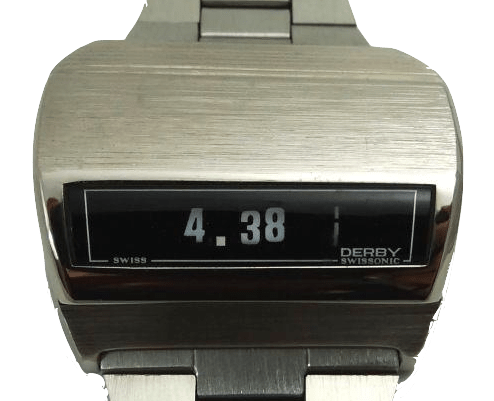
ESA was a parts and ultimately a caliber manufacturer for the Swiss watch industry for decades and was contractually prevented to sell complete watches, until it managed to circumvent this restriction with the creation of ‘Derby SA’, basically ESA’s own ‘watch brand’ around 1973 (3). The most iconic production using the ‘Derby’ name and later also sold to the French brand ‘JAZ’ was a watch featuring jumping hour and minutes, the electromechanical caliber ESA 9176 containing a high percentage of plastic elements. It was widely assumed, that plastic was increasingly used, exclusively because it permitted a cheaper manufacture of the caliber parts. While this is for sure a non neglect-able reason, especially in developments of the late 1970s, it must be emphasised, that initially watch manufacturers believed, that plastics would also have better material properties as compared to metal concerning weight, durability, auto-lubrication and overall performance of the calibers. New plastics, such as Delrin, were also tested as replacement for rubies (3).
Swatch

ETA was created by Schild Frères as the movement producing branch of ‘ETernA’ in 1926 in Grenchen and it joined Ebauches SA in 1932 (3, 6). After the joint (Ebauches SA + ETA) world record for the thinnest electronic watch achieved in 1979 (see subsection) with the development of the ‘Delirium Tremens‘, the new head of ETA SA, Ernst Thomke, together with the two engineers Jacques Müller and Elmar Mock, will set the pathway for the development of the ‘Delirium Vulgare’ which will be called Swatch starting from 1981. Thomke will rise to be director of Ebauches SA and will oversee the subsequent launch of Swatch in March 1983 (7).
Ref.:
- Personal communication with engineers working at the development of the MOSABA caliber
- Bramaz H.-R., Baumann H.; Die Elektrische Armbanduhr, Band 1, Verlag Stutz Druck AG, Wädenswil, 2013
- Comunication with a former Executive Vice-President of Ebauches SA, in charge of Research & Engineering.
- Watch-Wiki
- Swatchgroup
- Grail Watch
- Swatchprototypes
- Swatch-Prototypes
- Worthpoint
 Electric Watch Prototypes