
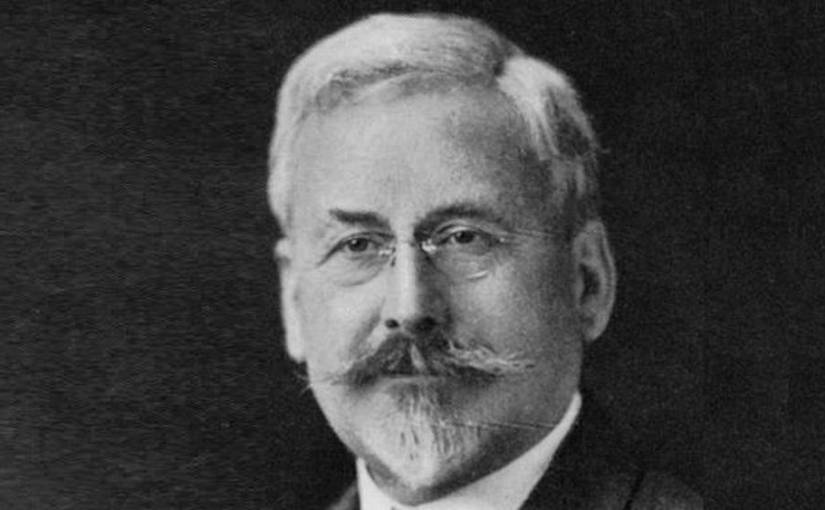
The ‘Prix Guillaume’ for precision regulation was named after Charles-Edouard Guillaume, the inventor of the Guillaume balance.

He was born at Fleurier, in the Swiss-Jura, 15.02.1861. His grandfather had left France for political reasons during the Revolution and established a watchmaking business in London. The business was carried on by his three sons but Charles’ father, Édouard, eventually returned to settle in Fleurier (1).
Guillaume received his early education in Neuchâtel before going to the ETH Zurich where he obtained his doctor’s degree. He spent a short time as an officer in the artillery before entering the International Bureau of Weights and Measures, as an assistant, in 1883. He became Associate Director in 1902 and from 1915 until his retirement in 1936, he was Director of the Bureau. He remained as Honorary Director from 1936 until his death (1).
During his brief military career, Guillaume studied mechanics and ballistics but his earliest investigations at the bureau were with thermometry. He carried out important investigations on corrections to mercury-in-glass thermometers and he was responsible for the detailed calibration of thermometers used at the Bureau in the establishment of the thermal expansions of the standards of length. He was concerned in initial work on the International Metre and undertook a determination of the volume of one kilogram of water by the contact method (1).
A chance observation by Guillaume on the coefficient of expansion of nickel-iron alloys led to a systematic investigation of a whole series of alloys and the discovery of invar, an alloy with a very low coefficient of expansion; elinvar, for which the thermoelastic coefficient is practically zero, i.e. Young’s modulus constant, over a considerable temperature range; together with other useful alloys. The applications of invar were quickly recognized and the material was used in rapid methods for the measurement of geodetic baselines. The alloy is widely used in instruments of precision, such as thermostats and pendulums of astronomic clocks. Guillaume’s total compensating balance for high-grade watches and chronometers, which eliminates the secondary error, was perfected by an elinvar hair spring (1).
Guillaume’s work is recorded in many papers published by the Bureau and he has written, amongst other works, Études thermométriques (Studies on Thermometry, 1886), Traité de thermométrie (Treatise on Thermometry, 1889), Unités et Étalons (Units and Standards, 1894), Les rayons X (X-Rays, 1896), Recherches sur le nickel et ses alliages (Investigations on Nickel and its Alloys, 1898), La vie de la matière (The Life of Matter, 1899), La Convention du Mètre et le Bureau international des Poids et Mesures (Metrical Convention and the International Bureau of Weights and Measures, 1902), Les applications des aciers au nickel (Applications of Nickel-Steels, 1904), Des états de la matière (States of Matter, 1907), Les récent progrès du système métrique (Recent progress in the Metric System, 1907, 1913). His book Initiation à la Mécanique (Introduction to Mechanics) has been translated into several languages (1).
–
CEH-204, Beta 2, ‘Prix Guillaume’, 14. February 1968

Prototype category: (proof of concept) – ephemera
Description: Rectangular laid paper sheet (yellowed) with black printing, topped by the coat of arms of the canton of Neuchâtel. Template printed by L .- A. Monnier, Neuchâtel. Typewriter printed text with description of the monetary prize content of ‘400 CHF’ (ca. 1300 CHF today) and the person winning the award (name covered, as per request of the family of the prize winner). Also mentioned is, that the prize concerns a ‘chronometer quartz wrist watch’. The ranking is declared by means of the precision factor ‘n = 0.330’ (n = 0 meaning absolute precision). Original, blue ball point signatures of prize committee representatives.
Size: 210 x 155mm
Associated Watch / Movement: CEH-204, Beta 2, prototype
Additional info: This is a very rare certificate for the ‘Prix Guillaume’ issued every year to master watch regulators adjusting and regulating watches and subsequently reaching excellent results during chronometer competitions at the ‘Observatory of Neuchâtel’. This certificate is even more historically important, as it concerns one of the first wrist watch sized quartz movements ever made, specifically CEH-204 Beta 2, which reached rank 12 in the category of quartz wrist watches during the most important chronometer competition at the ‘Neuchatel Observatory’ in 1967. As the results of the 1967 competition were published in February 1968, the certificate is dated 14. February 1968. As no more observatory competitions were held in the wrist watch category after 1967, this was one of the last ‘Prix Guillaume’ certificates for wrist watches to be issued.
When asked involved engineers upon their participation to the regulation of the pieces submitted to the observatory competition in the category of quartz watches, some reported that they did not personally finalise the regulation of the movements built by them for the competition, but that one specialist ‘regulator’ would work on all movements and optimise their performance, for Beta 1 and beta 2 it was Jean Hermann. To acknowledge the hard work of senior engineers developing these quartz watches, their name was assigned to some submitted movements they developed and built, declaring them ‘wrongly’ as regulators, so to allow them to be mentioned in case of a good enough ranking and win a monetary prize. As a consequence, it is not possible to be sure of the correctness of the attribution of the ‘regulator’ to the corresponding quartz watches in the official observatory bulletins. The only certain extractable information is, that the mentioned engineer was greatly involved in that movements development and construction.
This very democratic repartition of honours is confirmed for submitted quartz watches (also other than wrist watch sized), but it is unlikely that the mentioned procedure was also custom in the submission of mechanical pieces.
Some mechanical movements were repeatedly finished and optimised to chronometer specification and submitted over several years by highly specialised ‘regulators’, some of which became famed for their work and repeated wins at chronometer competitions.
Ref.:
 Electric Watch Prototypes