
Beta – Project Quartz module Prototype #40, 1966/67




Prototype category: proof of concept
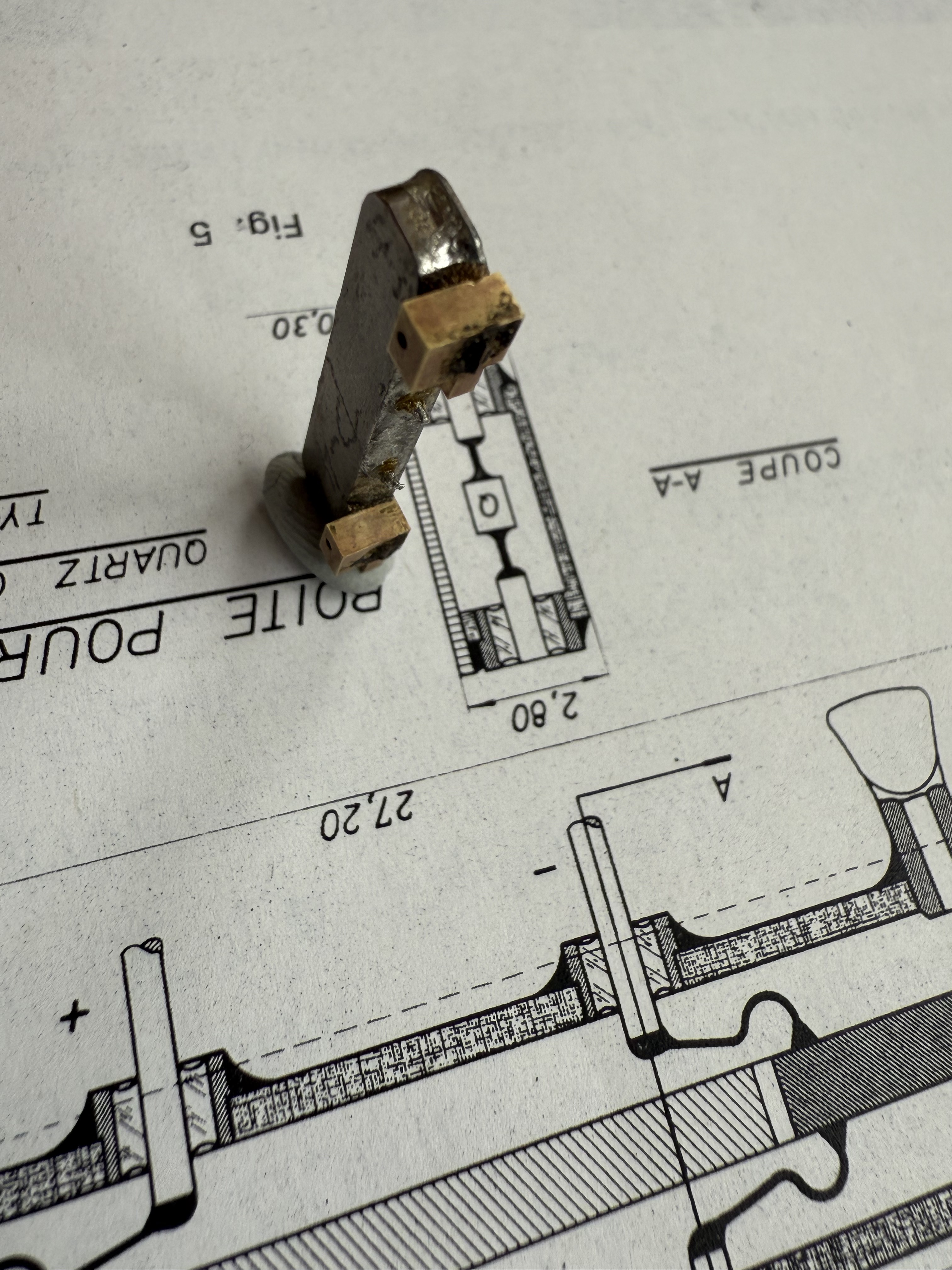
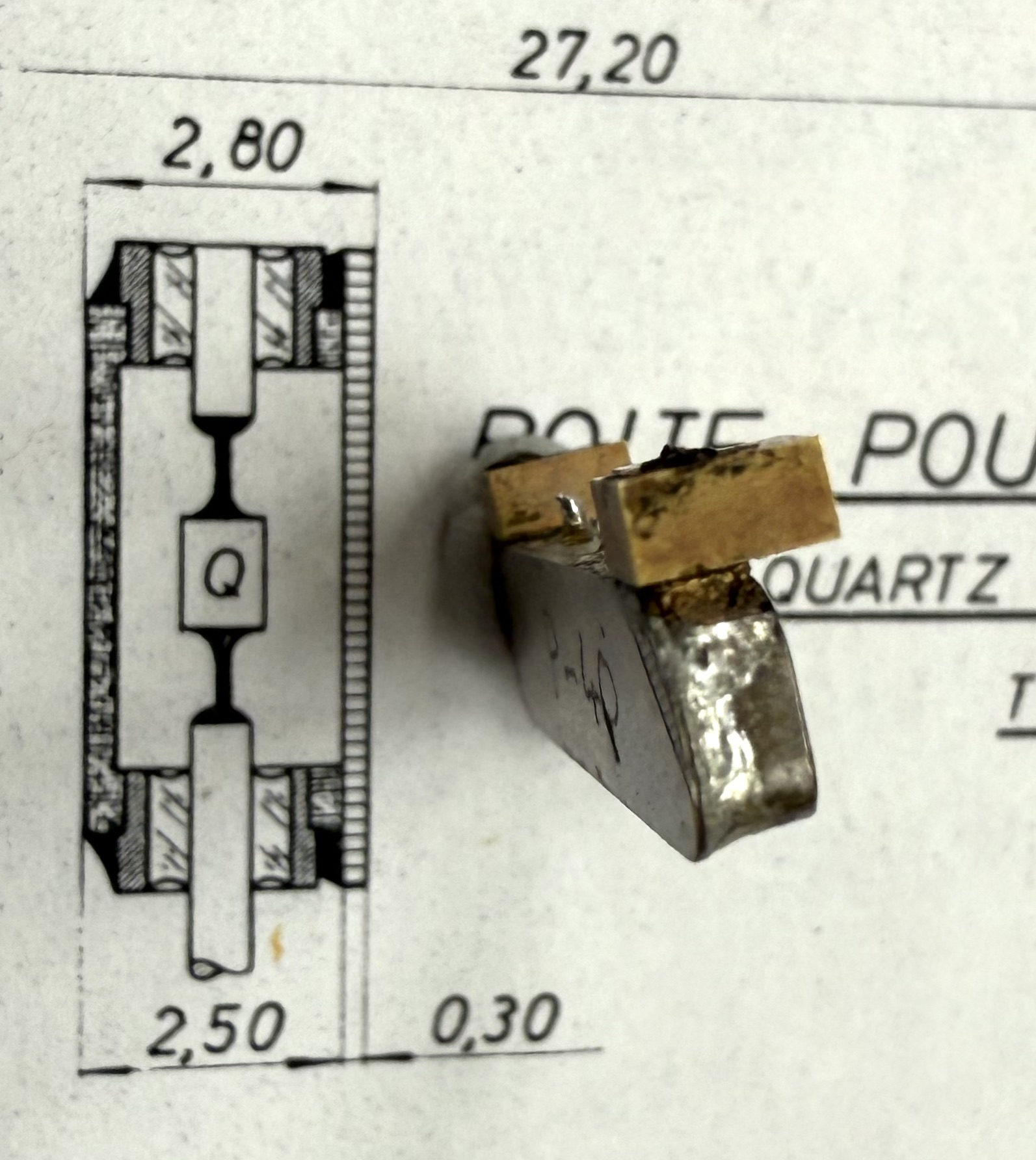
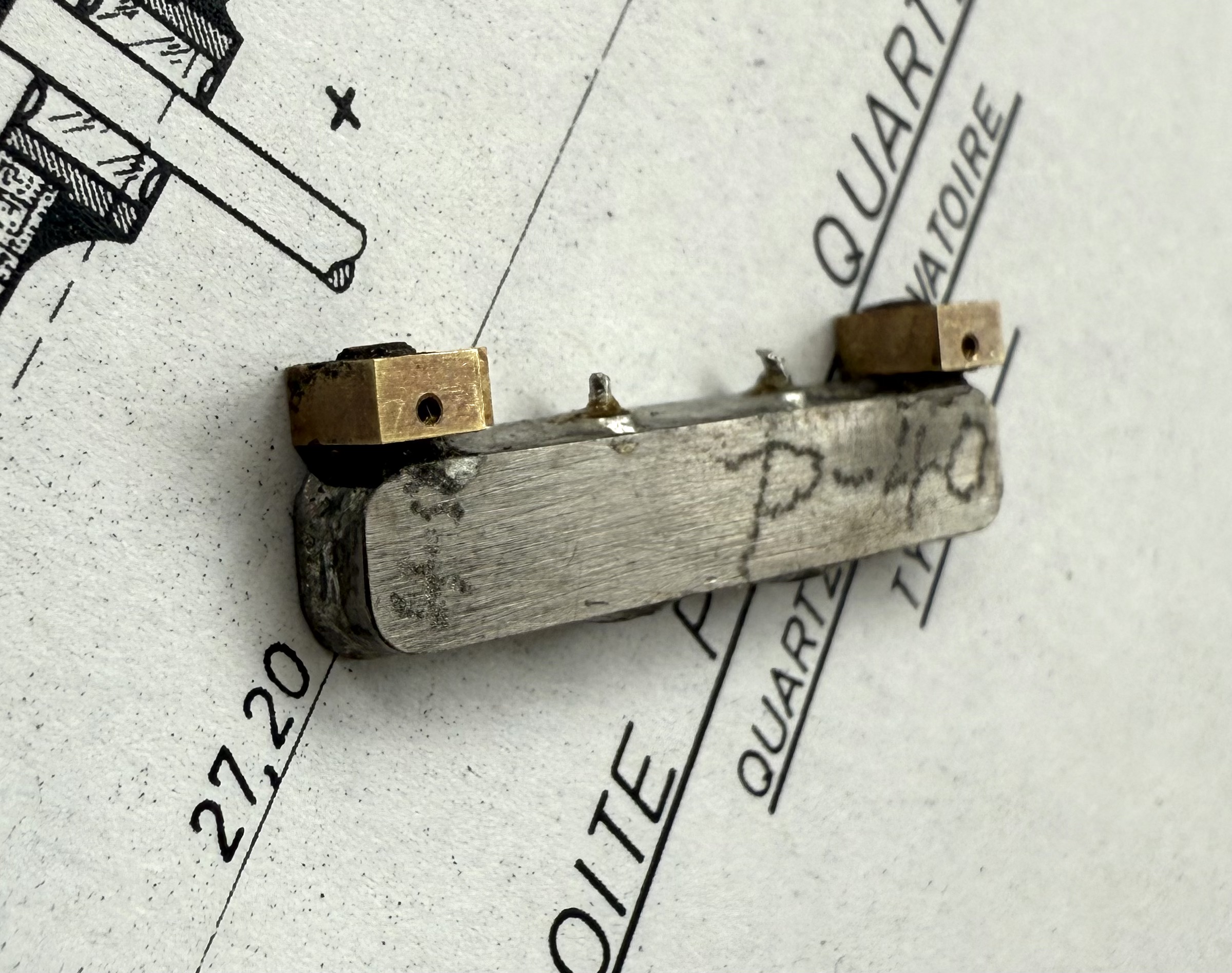
Description: Small metallic capsule (for dimensions see schematic below) containing hand cut and suspended quartz bar. The metallic capsule is hand soldered from sheet metal and shows two soldered, machined brass blocks with threaded and unthreaded holes for attachment to a support and to an electronic control circuitry.
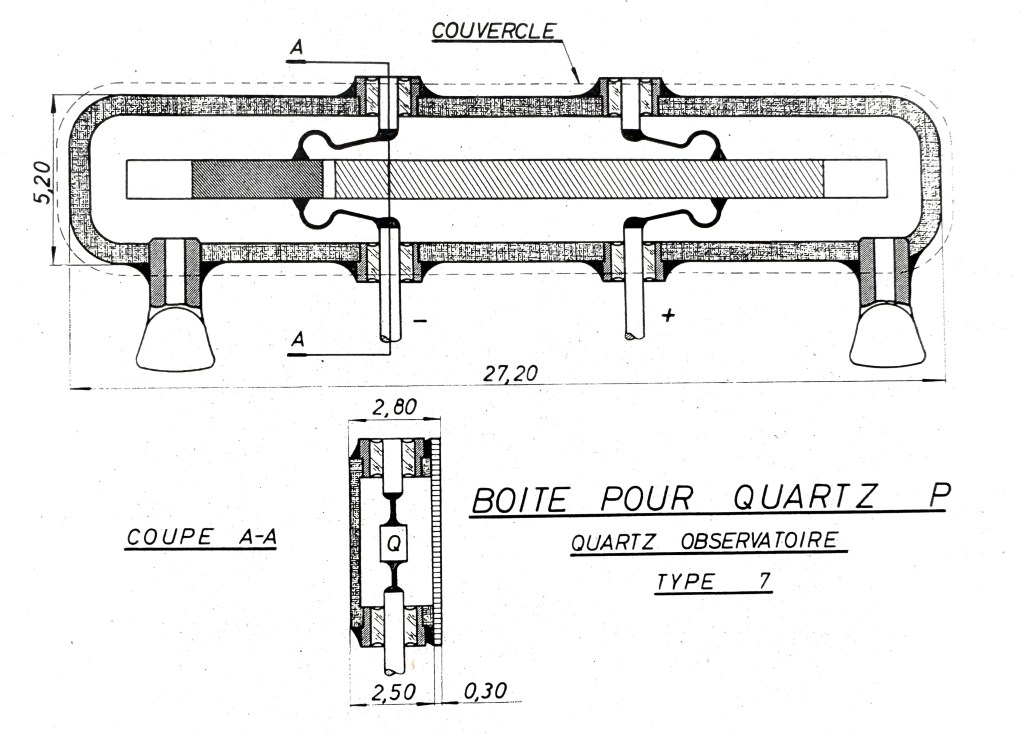
These two blocks are slotted and soldered on to two cut and sealed brass tubes used in the process of flushing the inside of the capsule for cleaning and for the subsequent ‘vacuumisation’ process.

Two small rods as continuity of the quartz suspension protruding from one narrow flank between the two brass blocks are used for connecting the electric alimentation and control circuitry. On the opposite narrow flank two soldered openings hide the other two quartz suspension rods. Both major surfaces of the capsule hand engraved ‘P-40′ and on one same surface but a little smaller a hand engraved ’40’.
Movement: Isolated quartz module compatible with Beta 1 and Beta 2 calibers.
Additional info: This historic quartz module belongs to the earliest batch of wrist watch sized quartz modules ever made. It was hand made and hand engraved by Armin Frei at the CEH in Neuchâtel in late 1966 or early 1967, with the help of one engineer working at Oscilloquartz SA, before Armin Frei left the CEH around March 1967 (1).
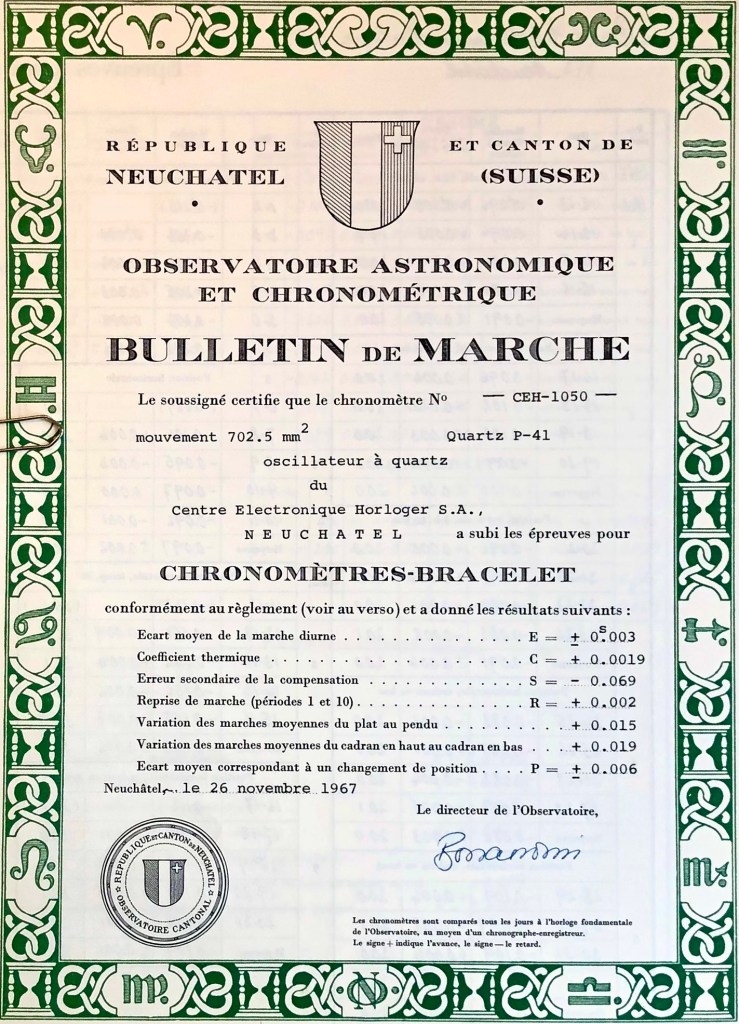
The ’40’ of the engravings ‘P-40’ corresponds to the numbering of these quartz modules of which not more than 50 were made (1). ‘P-41’ for example was used in CEH-105 Beta 1, see a picture of its ‘Bulletin de Marche’ below.
The isolated and smaller engraved ’40’ might correspond either to the abbreviation of the quartz module number or to a quality check confirming that the quartz shows a series resonance impedance of 40 Ohm, witch for a working frequency of 8192Hz is ideal. Hence, it would confirm that this resonator was functioning properly and is exhibiting a normal quality factor. This fact is a prerequisite for attaching further elements for their later testing and adjustments, isolating eventual problems outside of the quartz module (1).
This module was thus most probably used to test the earliest versions of the quartz control circuitry and to refine Rolf Lochinger’s frequency division circuitry prior to the finalisation of the Beta 1 caliber (1).
The ‘P’ before the ’40’ indicates the use of small (23.4 x 1.2 x 0.8mm) Prototype X-Y cut P-Quartz bars (Observatory quartz types, 5 to 7) smaller than the then usual O-Quarzes (Observatory quartz types 3 and 4; 30 – 40mm) used for observatory standard clocks and laboratory reference clocks at the CEH. After hand cutting and finishing the quartz bars, they were metal coated to allow for an appropriate electrical field inside the quartz upon application of an electric tension from outside (2).
When this module was recently tested at the Integrated Circuits Laboratory of the ETH in Zurich (Switzerland), the hand cut quartz bar inside showed normal response to an appropriate electrical excitation.
The resonance of the quartz bar at the intended frequency of around 8192Hz when triggered, proves that the quartz bar is still securely suspended and that the quartz module is still correctly working after almost 60 years.

For the industrialised version Beta 21 the size and the principles of the quartz module will be preserved, but the construction will be optimised. All the accesses for ‘vacuumisation’, anchoring of the suspension and electrical connections will be transferred to the bottom of the casing and be hidden, once the quartz module is connected to the control circuitry. The 4 point suspension of the quartz bar will be optimised to withstand shocks while wearing the watch. A patent will be filed for this optimisation in November 1970, 7 months after presenting the Beta 21 at the Basle Fair of 1970!
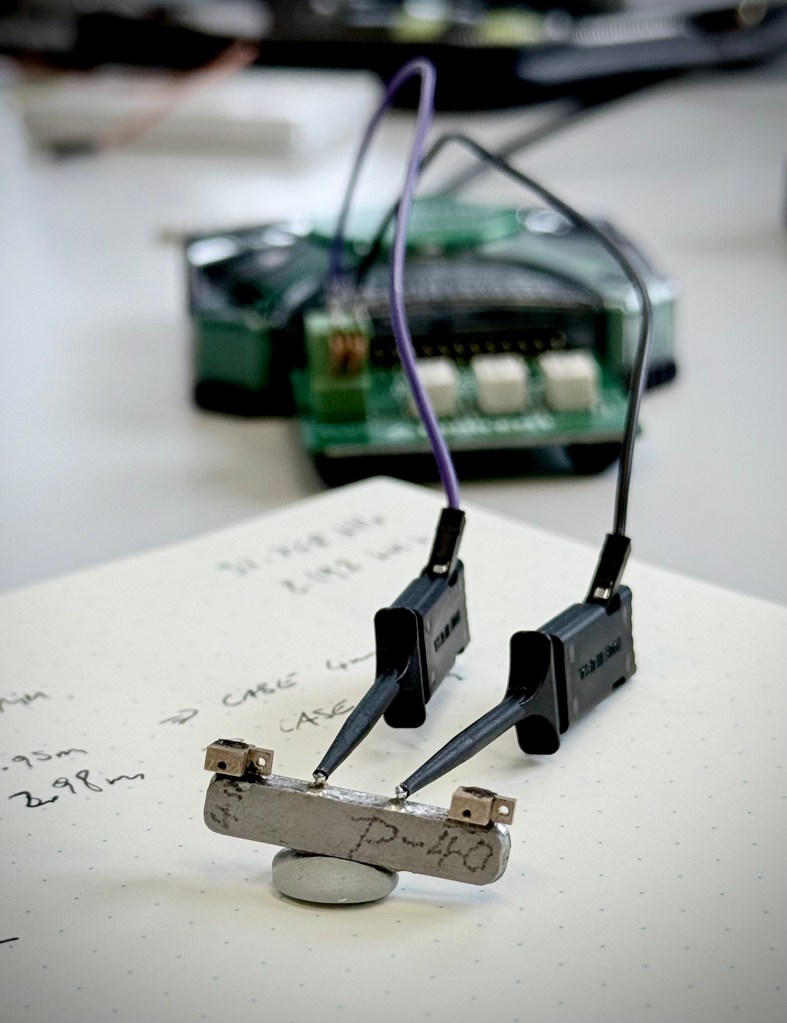
Acknowledgements: Many thanks to the team of the Integrated Circuits Laboratory at the ETH Zurich for improvising a testing rig to confirm the functioning of this historic piece.
Ref.:
- Personal communication with a former Executive Vice-President of Ebauches SA, in charge of Research & Engineering. He was a friend of the late Armin Frei.
- CEH, report of the internal seminar of the 19.12.1967, MIH La Chaux – de – Fonds Archive, #CEH 36.4
 Electric Watch Prototypes